

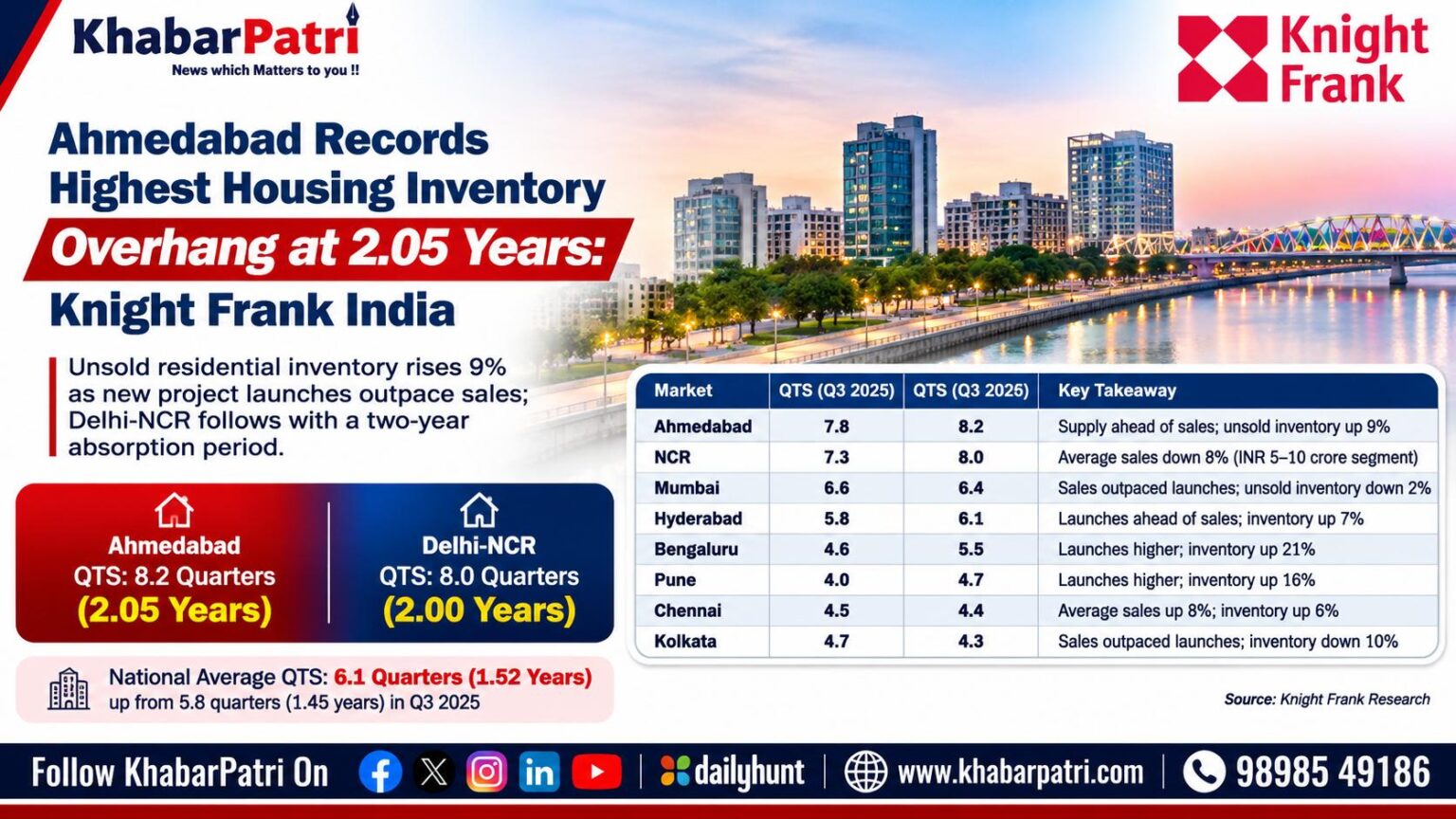
Unsold residential inventory rises 9% as new project launches outpace sales; Delhi-NCR follows with a two-year absorption period
Ahmedabad : Ahmedabad recorded the highest residential inventory overhang among India’s eight major housing markets in the third quarter of 2026, with the time required to sell existing unsold homes increasing to 2.05 years, according to the latest research by Knight Frank India.
The report, which tracks the residential market through its Quarters to Sell (QTS) metric, found that Ahmedabad’s QTS increased from 7.8 quarters (1.95 years) in Q3 2025 to 8.2 quarters (2.05 years) in Q3 2026. The metric measures the time required to absorb existing inventory at the average sales rate recorded over the previous eight quarters.
The increase in Ahmedabad’s inventory overhang was primarily driven by strong new project launches, which kept housing supply ahead of sales-led absorption. Consequently, unsold residential inventory increased by 9% year-on-year, compared with a 3% rise in average sales.
Delhi-NCR also witnessed a longer inventory absorption cycle, with its QTS rising from 7.3 quarters (1.8 years) in Q3 2025 to 8.0 quarters (two years) in Q3 2026. Although unsold inventory remained stable, average sales declined by 8%, mainly due to moderation in demand for luxury homes priced between ₹5 crore and ₹10 crore.
National Housing Market Records a Marginal Increase in Inventory Overhang
Across India’s eight leading residential markets, the average QTS increased to 6.1 quarters, equivalent to 1.52 years, in Q3 2026 from 5.8 quarters (1.45 years) in the corresponding period last year. Despite the marginal rise, the current absorption period remains below the seven to eleven quarters recorded between 2018 and 2021.
Among the other major markets, Mumbai’s QTS improved from 6.6 to 6.4 quarters, while Chennai and Kolkata recorded declines to 4.4 and 4.3 quarters, respectively. Hyderabad’s QTS increased to 6.1 quarters, Bengaluru to 5.5 quarters and Pune to 4.7 quarters.
Commenting on the findings, Gulam Zia, International Partner, Senior Executive Director – Research, Advisory, Infrastructure and Valuation, Knight Frank India, said, “Despite a marginal increase in Quarters to Sell, the Indian residential market, with an average QTS of 6.1 quarters, continues to demonstrate resilience. While NCR and Ahmedabad are witnessing longer absorption periods, QTS across the other six markets ranges from 4.3 to 6.4 quarters, signalling that the Indian residential market’s fundamentals remain sound.”
The findings highlight the contrasting trends across India’s residential markets, with Ahmedabad and Delhi-NCR experiencing longer inventory absorption periods, while several other cities continue to record relatively lower QTS levels.