

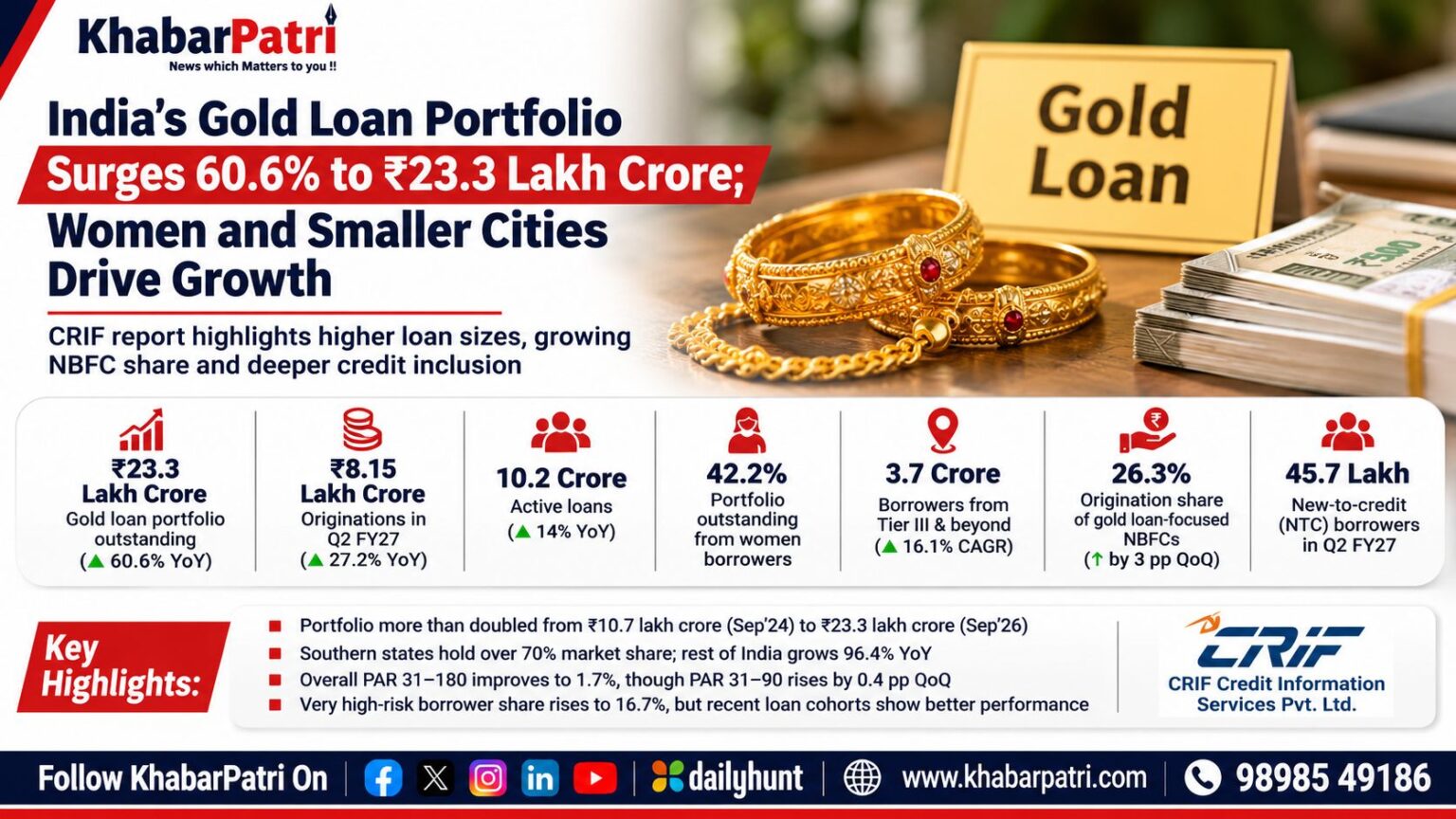
Gold loan originations reach ₹8.15 lakh crore in Q2 FY27, while specialised NBFCs increase their market share
Mumbai : India’s gold loan market continued its strong growth trajectory, with portfolio outstanding reaching ₹23.3 lakh crore as of September 2026, registering a 60.6% year-on-year (YoY) increase, according to the latest report released by CRIF Credit Information Services Private Limited.
The report highlights expanding participation across geographies and borrower segments, with larger loan ticket sizes and growing contributions from specialised gold loan-focused NBFCs. Gold loans accounted for 12.6% of India’s ₹185.2 lakh crore retail loan portfolio.
Active gold loans increased 14% YoY to 10.2 crore, while the number of borrowers grew from 3.7 crore in September 2023 to 5.6 crore in September 2026, registering a three-year CAGR of 15.6%.
Key Findings from the Report
1. Strong portfolio growth: Gold loan portfolio outstanding more than doubled from ₹10.7 lakh crore in September 2024 to ₹23.3 lakh crore in September 2026. Priority-sector gold loans stood at ₹8.2 lakh crore, accounting for 35.1% of the total portfolio.
2. Higher loan values despite lower account volumes: Gold loan originations reached ₹8.15 lakh crore in Q2 FY27, up 27.2% YoY. However, origination volumes declined 4.1% to 369.4 lakh accounts, indicating an increase in average loan ticket sizes.
3. Women and smaller cities drive inclusion: Women borrowers increased to 2.4 crore, recording a three-year CAGR of 16%. Borrowers from Tier III and beyond cities grew at a 16.1% CAGR to 3.7 crore. Women accounted for 42.2% of the gold loan portfolio outstanding.
4. New-to-credit borrowers enter the market: Approximately 45.7 lakh borrowers who accessed gold loans in Q2 FY27 were new-to-credit (NTC) customers, highlighting the role of gold loans in expanding formal credit access.
5. Southern states continue to lead: Southern India accounted for over 70% of the market. Tamil Nadu led with ₹6.9 lakh crore, followed by Andhra Pradesh at ₹3.7 lakh crore, Karnataka at ₹2.4 lakh crore, Telangana at ₹2.1 lakh crore and Kerala at ₹1.7 lakh crore. The rest of India also recorded strong portfolio growth of 96.4% YoY.
6. Specialised NBFCs gain market share: Gold loan-focused NBFCs increased their share of origination value to 26.3% in Q2 FY27, compared with 23.3% in Q1 FY27 and 20.5% in Q2 FY26.
Risk Trends and Portfolio Quality
The report also highlights mixed trends in portfolio quality. Overall PAR 31–180 improved from 2% in September 2025 to 1.7% in September 2026. However, PAR 31–90 increased sequentially by 0.4 percentage points between June and September 2026.
The share of very high-risk borrowers rose from 14.8% in September 2024 to 16.7% in September 2026. At the same time, vintage analysis indicated improving delinquency trends in more recent loan cohorts, with peak delinquency at 12 months on book declining from 1.6% for Q3 FY25 originations to approximately 0.4% for Q1 FY26 originations.
The findings underline the continued expansion of India’s gold loan market, supported by larger loan sizes, increasing participation from women, deeper penetration in smaller cities and access to new-to-credit borrowers. While early-stage delinquencies remain an area to monitor, the growth in borrower participation and improving performance in recent loan cohorts point to an evolving and increasingly inclusive gold loan market.