

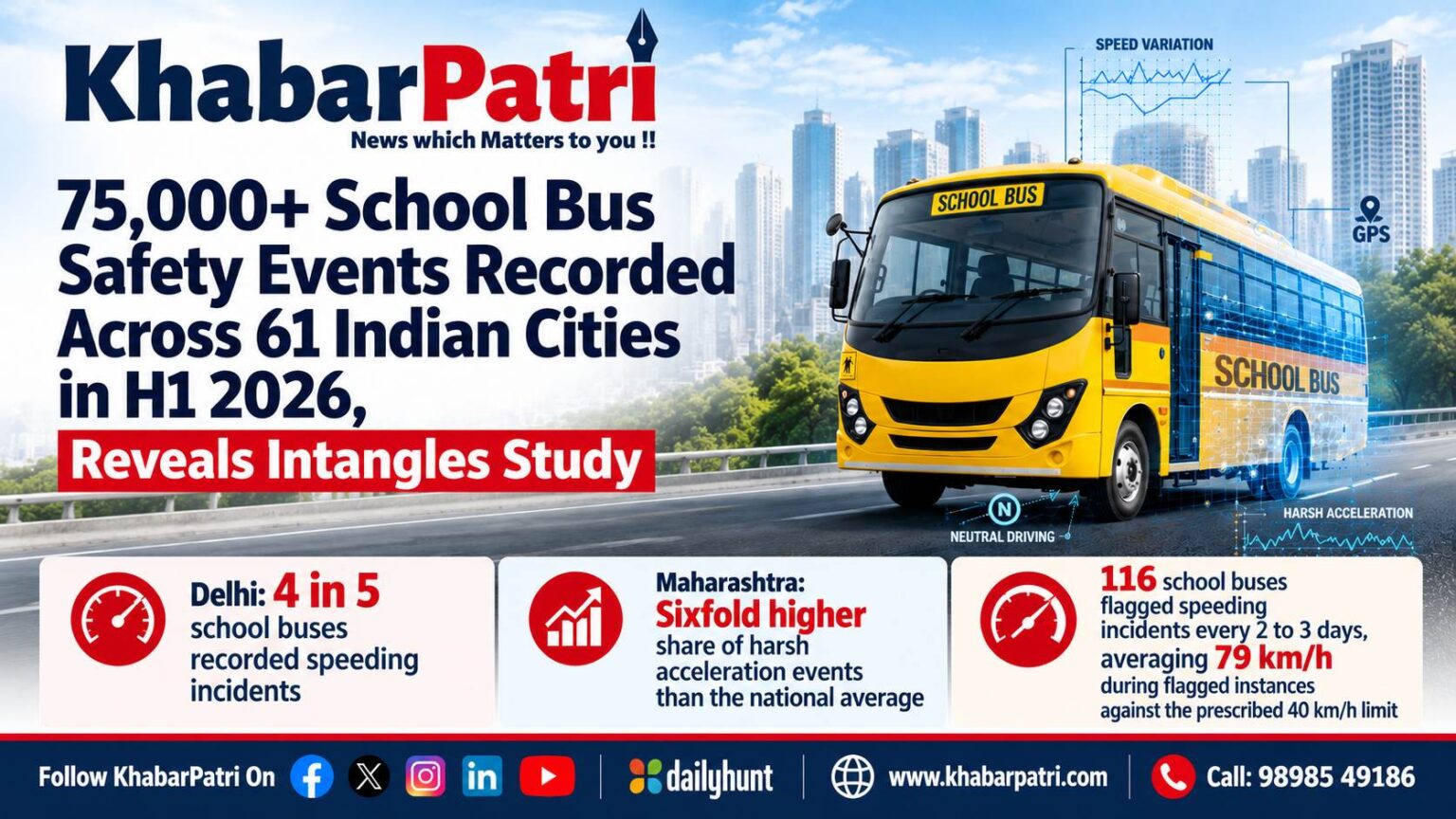
Delhi emerges as a major concern, with four in five school buses recording speeding incidents; Maharashtra reports six times the national average share of harsh acceleration events
Pune: Intangles, a global AI-powered prescriptive analytics company specialising in commercial fleets and mobility analytics, has released a study highlighting more than 75,000 flagged driving safety events across 598 school buses operating in 61 Indian cities during a six-month period in 2026. The findings point to recurring concerns around speeding, hard braking and harsh acceleration, underlining the need for continuous monitoring of school bus driving behaviour.
The study, titled Interesting Angles – Episode 2: Beyond the Rulebook, found that one in five school buses analysed recorded at least one speeding incident. In Delhi, the proportion rose to four in five buses, highlighting significant regional variations in driving behaviour. Maharashtra also emerged as an area of concern, recording a sixfold higher share of harsh acceleration events than the national average.
The analysis identified 116 school buses that recorded speeding incidents every two to three days. During these flagged instances, the buses travelled at an average speed of approximately 79 km/h, significantly exceeding the prescribed speed limit of 40 km/h cited in the study. The findings highlight the importance of continuous driving behaviour monitoring beyond mandatory speed governors and standard GPS tracking systems.
Hard Braking Emerges as the Most Common Safety Concern
Hard braking accounted for 81.5% of all flagged safety events recorded in the study. On average, each school bus registered 126 flagged events over six months, including approximately 103 hard braking incidents — equivalent to nearly one incident every two school days.
The study also identified a pattern termed the “Bell Effect”, with hard braking incidents rising sharply between 7 AM and 8 AM across geographies. The timing coincides with the morning school commute, when traffic congestion, tight schedules and the pressure to reach school before the bell rings may influence driving conditions.
While the analysis does not establish a direct cause, the recurring pattern highlights the importance of considering operational pressures alongside individual driving behaviour when assessing school transportation safety.
The study further compared driving behaviour alerts in school buses and city buses. Hard braking accounted for 81.5% of school bus alerts, compared with 38.9% in city buses. Harsh acceleration represented 4.6% of alerts in school buses against 1.8% in city buses, while coasting accounted for 2.9% and 0.4%, respectively. These figures reflect the distribution of alerts within each vehicle category rather than the frequency of incidents per journey.
Maharashtra Records Higher Share of Harsh Acceleration Events
Regional analysis revealed notable differences in driving behaviour across Maharashtra. Harsh acceleration accounted for 30% of flagged events in the state’s regional comparison, six times the national average of 5%.
Within Maharashtra, Pune recorded a 42% share of harsh acceleration events, compared with 15% in Mumbai. The findings suggest a need for closer examination of driving behaviour and operating conditions across locations, rather than attributing these patterns solely to traffic congestion.
Commenting on the findings, Anup Patil, CEO, Intangles, said, “School bus safety is often measured by whether a vehicle meets prescribed regulations, from speed governors and GPS tracking to onboard safety equipment. But compliance does not necessarily tell us how safely a child is being driven. Our analysis found recurring instances of speeding and hard braking across school buses, with some of these behaviours occurring repeatedly during routine journeys. What is equally important is understanding the conditions in which these incidents occur.”
Vikram Melapudi, Chief AI Scientist, Intangles, said, “Schools and safety officers need greater visibility into real world driving behaviour so they can identify recurring risks, address unsafe practices and strengthen driver accountability. The focus must shift from simply checking whether a bus is compliant to continuously assessing how safely it is being operated.”
Strengthening Safety Across Existing School Bus Fleets
The findings come amid evolving school transportation safety requirements. Maharashtra’s July 2026 rules introduced additional measures covering seat belts, CCTV, live video access, GPS tracking, panic buttons, digital attendance and integration with state monitoring systems. At the national level, Advanced Driver Assistance Systems (ADAS) are also being phased into newly manufactured buses and trucks between 2026 and 2028.
With existing vehicles continuing to operate across school transportation networks, the study highlights the importance of strengthening safety practices across current fleets.
Intangles emphasises that driving behaviour monitoring, real-world trip data, cameras and structured driver coaching can help schools and fleet operators identify unsafe driving patterns and implement corrective measures. Integrating these capabilities with existing safety requirements can improve visibility into everyday school transportation operations, strengthen driver accountability and support safer journeys for students.