

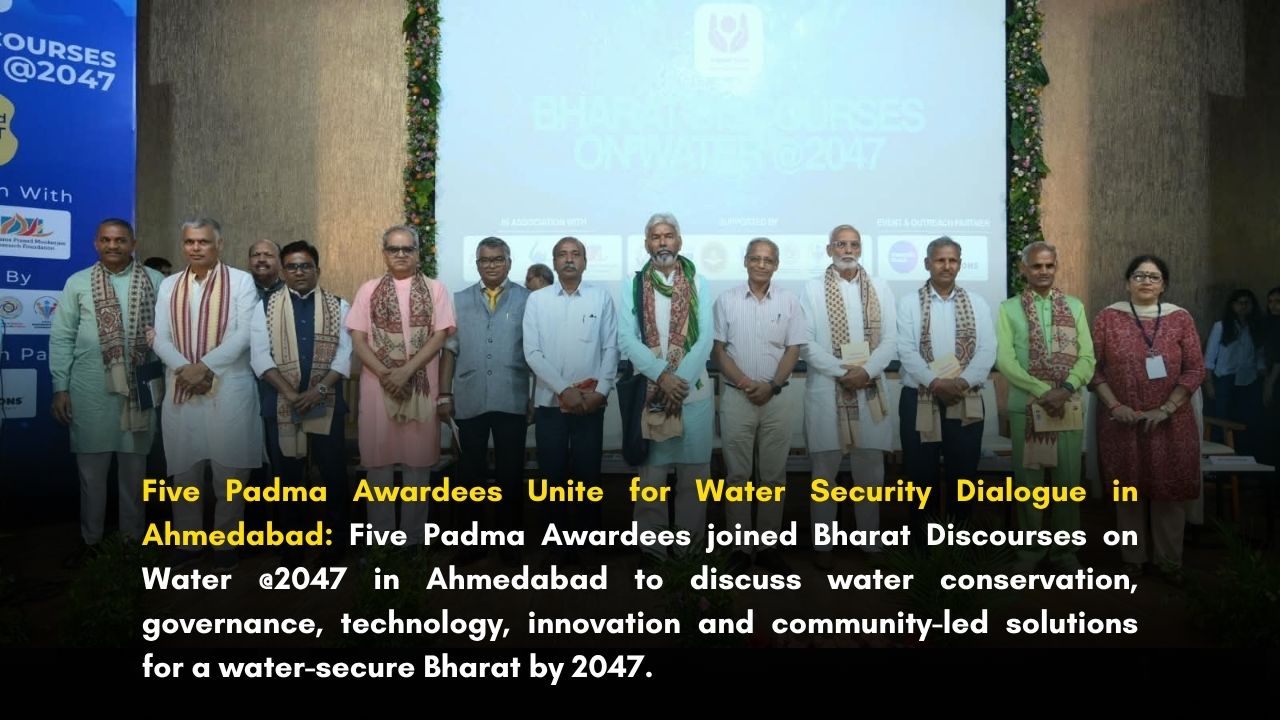
Ahmedabad: Five Padma Awardees associated with water conservation, environment and community development came together in Ahmedabad for the two-day ‘Bharat Discourses on Water @2047’, a national dialogue focused on building a water-secure India by 2047.
Organised by Udgam Charitable Trust, Gandhinagar, in association with the Center for Water Peace (CWP), Dr. Syama Prasad Mookerjee Research Foundation (SPMRF) and I-HUB, the conclave brought together policymakers, scientists, researchers, water experts, innovators and grassroots practitioners to discuss India’s water challenges and explore solutions spanning governance, technology, research, innovation and community participation.
Held at the KCG Auditorium in Ahmedabad, the conclave featured participation from prominent policymakers, academicians, environmentalists and grassroots leaders, including Shri Vinay Sahasrabuddhe, Former Member of Parliament, Rajya Sabha and Former President, ICCR; Shri Binay Kumar Singh, Director, SPMRF; Dr. Vivek Kumar, Director, Centre for Rural Development and Technology, IIT Delhi; Prof. (Dr.) Ami Upadhyay, Hon. Vice Chancellor, BAOU; Padma Shri Mahesh Sharma; Shri Chiranjivi Patel; and Shri Vijay Baghel, popularly known as the ‘Greenman of India’.
Focus on Conservation and Community Participation
The inaugural day focused on the importance of water conservation and greater public participation. The opening session was chaired by Padma Bhushan Dr. Anil Prakash Joshi and attended by Smt. Darshnaben Vaghela, State Minister for Urban Development, Government of Gujarat, as Chief Guest, along with Shri Shaileshbhai Patel, Prant Karyavah, Rashtriya Swayamsevak Sangh, Gujarat Prant, and other dignitaries.
Sessions on ‘Bharatiya Wisdom of Water’, ‘Water Circularity’ and ‘Jan Bhagidari in Action’ examined India’s traditional water systems, sustainable water management practices and the role of communities in conservation.
The Water Circularity session explored efficient water use, reuse and innovative approaches to long-term water security, while Jan Bhagidari in Action brought grassroots experiences and community-led conservation models to the forefront.
Vishwamitri River Restoration Highlighted
Shri Dilip Rana, IAS, Commissioner of Higher and Technical Education, Government of Gujarat, shared insights into interventions undertaken for the Vishwamitri River, including restoration efforts that helped address flooding challenges in Vadodara.
His observations highlighted the importance of timely planning, scientific interventions and coordinated action in managing urban water systems and reducing flood risks.
The first day also featured a poster presentation on research and innovation in water management, followed by a technical field visit to the historic Adalaj Stepwell (Adalaj ni Vav). Participants explored its traditional water architecture, groundwater recharge systems and community-based water management practices.
Padma Awardees Call for Collective Action
Padma Bhushan Dr. Anil Prakash Joshi emphasised the importance of collective responsibility in water conservation. “Water is not merely a resource but the foundation of life. ‘Water for All’ can only become a reality when individuals, communities and governments take collective responsibility for conserving every drop.”
Padma Shri Umashankar Pandey highlighted the importance of community ownership and traditional knowledge. “Water conservation begins with communities. When people take ownership of local water resources and revive traditional practices, conservation becomes a people’s movement.”
Research, Innovation and Water Governance
The second day shifted the focus towards implementation, policy, research and innovation. A research colloquium titled ‘From Water Challenges to National Opportunities: Research, Innovation and Pathways for Bharat @2047’ examined the role of academic research, scientific interventions and innovation in addressing water security and climate-related challenges.
The session ‘Shaping Water Governance, Public Policy and the Road to a Water-Secure Bharat’ explored stronger coordination between governments, institutions, researchers and communities.
The conclave also examined emerging technologies and startup-led solutions through ‘Innovation for Every Drop’, while discussions on green finance and climate-resilient water systems focused on sustainable investment in water infrastructure, conservation and resilience initiatives.
Padma Shri Bharat Bhushan Tyagi said: “Water security is an investment in our collective future. Development must move in harmony with nature, and every solution must strengthen communities while protecting resources for future generations.”
Padma Shri Sathpal Singh stressed that lasting water conservation requires active participation from communities. “Every village, household and community must see water as a shared responsibility. When conservation becomes a way of life, lasting change becomes possible.”
Traditional Knowledge Meets Modern Solutions
The discussions highlighted traditional water conservation systems such as johads, baolis and kunds, while examining ways to integrate India’s traditional knowledge with modern science, technology, innovation and public policy.
Dr. Mayur Joshi, Managing Trustee, Udgam Charitable Trust, said that water security would be essential to India’s journey towards Viksit Bharat. “The responsibility goes beyond governments and institutions. It requires communities, researchers, innovators and citizens to come together and transform concern into collective action.”
Roadmap Towards a Water-Secure Bharat
During the valedictory session, Dr. Vivek Kumar, Director, Centre for Rural Development and Technology, IIT Delhi, emphasised the need to expand the scope of Bharat Discourses on Water by connecting water-related concerns with other critical issues and promoting a more integrated approach to sustainable development.
Shri Amrish Kumar, Kshetra Pracharak, Ganga Samagra, appealed to citizens and stakeholders to contribute towards water conservation, describing the protection and preservation of water as a collective responsibility. Delivering the vote of thanks, Shri Sanjay Kashyap, CMD, Center for Water Peace, urged stakeholders to remain connected with the initiative and contribute according to their respective capacities.
The deliberations and recommendations emerging from the conclave are expected to contribute towards the proposed ‘Bharat Water Manifesto 2047’, with the objective of strengthening awareness, informing policy and encouraging collective action for water conservation and water security.
The two-day conclave concluded with a collective call for sustained collaboration among governments, institutions, researchers, innovators, communities and citizens to address India’s water challenges and work towards a water-secure Bharat by 2047. SEO Keywords: Bharat Discourses on Water 2047, water security Ahmedabad, five Padma Awardees water conclave, water conservation Gujarat, water management India, Bharat Water Manifesto 2047, Udgam Charitable Trust, Center for Water Peace, water conservation Ahmedabad