

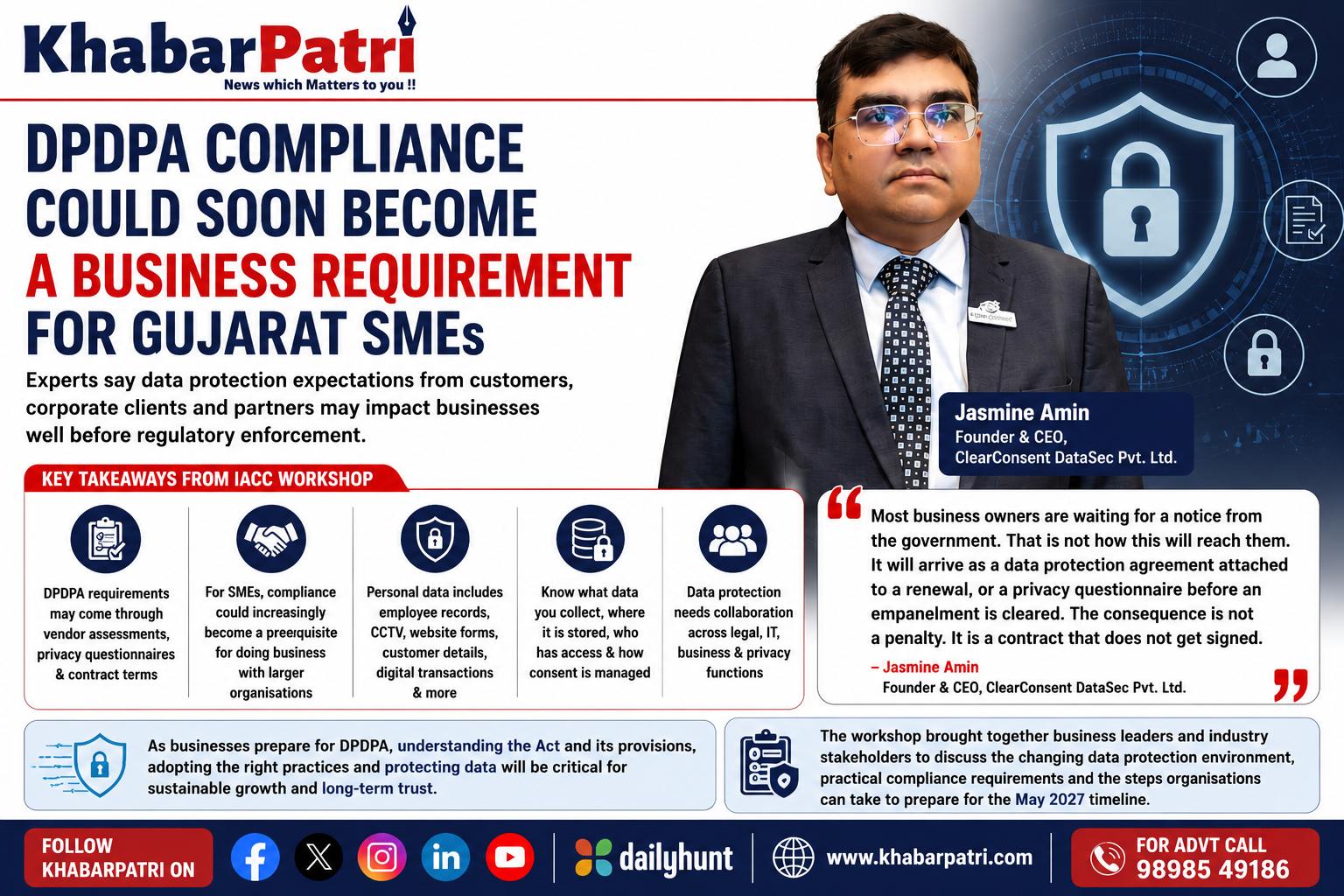
Ahmedabad : As India moves towards the implementation of the Digital Personal Data Protection Act (DPDPA), data privacy is emerging as an increasingly important business requirement for small and mid-sized enterprises across Gujarat. While regulatory enforcement remains a key consideration, businesses could encounter data protection requirements much earlier through customer expectations, vendor assessments, privacy questionnaires and contractual obligations imposed by larger organisations.
The implications were discussed at a workshop organised by the Indo-American Chamber of Commerce (IACC), Gujarat Branch, in association with ClearConsent DataSec Pvt. Ltd. The session, titled “The DPDPA Countdown: What Every Business Must Do Before May 2027,” was held at DoubleTree by Hilton, Bopal Ambali Road, Ahmedabad.
The discussion focused on how data privacy is increasingly moving beyond a legal and technology issue to become an important element of business continuity, vendor relationships and corporate trust. For SMEs operating as suppliers, service providers or partners within larger corporate ecosystems, demonstrating responsible data practices could increasingly become part of the process of securing and retaining business. Companies may be required to explain how personal data is collected, stored, accessed, processed and protected as part of vendor onboarding, contract renewals or corporate assessments.
Jasmine Amin, Founder & CEO, ClearConsent DataSec Pvt. Ltd., emphasised that businesses should begin preparing for data protection requirements rather than waiting for regulatory enforcement. “Most business owners are waiting for a notice from the government. That is not how this will reach them,” said Amin. “It will arrive as a data protection agreement attached to a renewal, or a privacy questionnaire before an empanelment is cleared. The consequence is not a penalty. It is a contract that does not get signed.”
The workshop highlighted that the scope of personal data handled by businesses extends well beyond customer databases. Organisations routinely collect and process information through employee records, CCTV footage, website enquiry forms, customer contact details, digital transactions and other day-to-day business operations.
For SMEs, the first step towards data privacy readiness is understanding the personal data they already handle. This includes identifying what information is collected, where it is stored, who can access it, how consent is managed and what procedures are available to respond to potential data breaches.
Amit Doshi, Chairperson, Indo-American Chamber of Commerce, Gujarat Branch, stressed the importance of building awareness among businesses, particularly MSMEs and SMEs.
“It is very vital and critical for the industry, and for all of us, to understand the Act and its implications. As an industry and as businesses, we need to protect our businesses, comply with the requirements, sustain ourselves and continue to grow,” said Doshi.
He further highlighted the need for businesses to understand the provisions of the Act, adopt appropriate practices for protecting their information and reduce the risk of misuse of operational and business data. “Unless businesses understand the provisions of the Act, they may remain vulnerable to the misuse of their basic operational and business information,” he added.
The session also emphasised that effective data protection cannot be treated as the responsibility of a single department. Preparing for DPDPA-related requirements may require coordination across legal, technology, business operations and privacy functions.
For Gujarat’s SME ecosystem, this means data privacy could increasingly become part of everyday business processes — from handling employee and customer information to managing digital transactions, third-party vendors and corporate contracts. The workshop brought together business leaders and industry stakeholders to discuss the evolving data protection environment, practical compliance considerations and the steps organisations can take to strengthen their privacy practices ahead of the May 2027 timeline.
As businesses prepare for the changing data protection landscape, building visibility over personal data, strengthening internal processes and establishing clear accountability could help organisations respond more effectively to evolving customer, partner and regulatory expectations.