

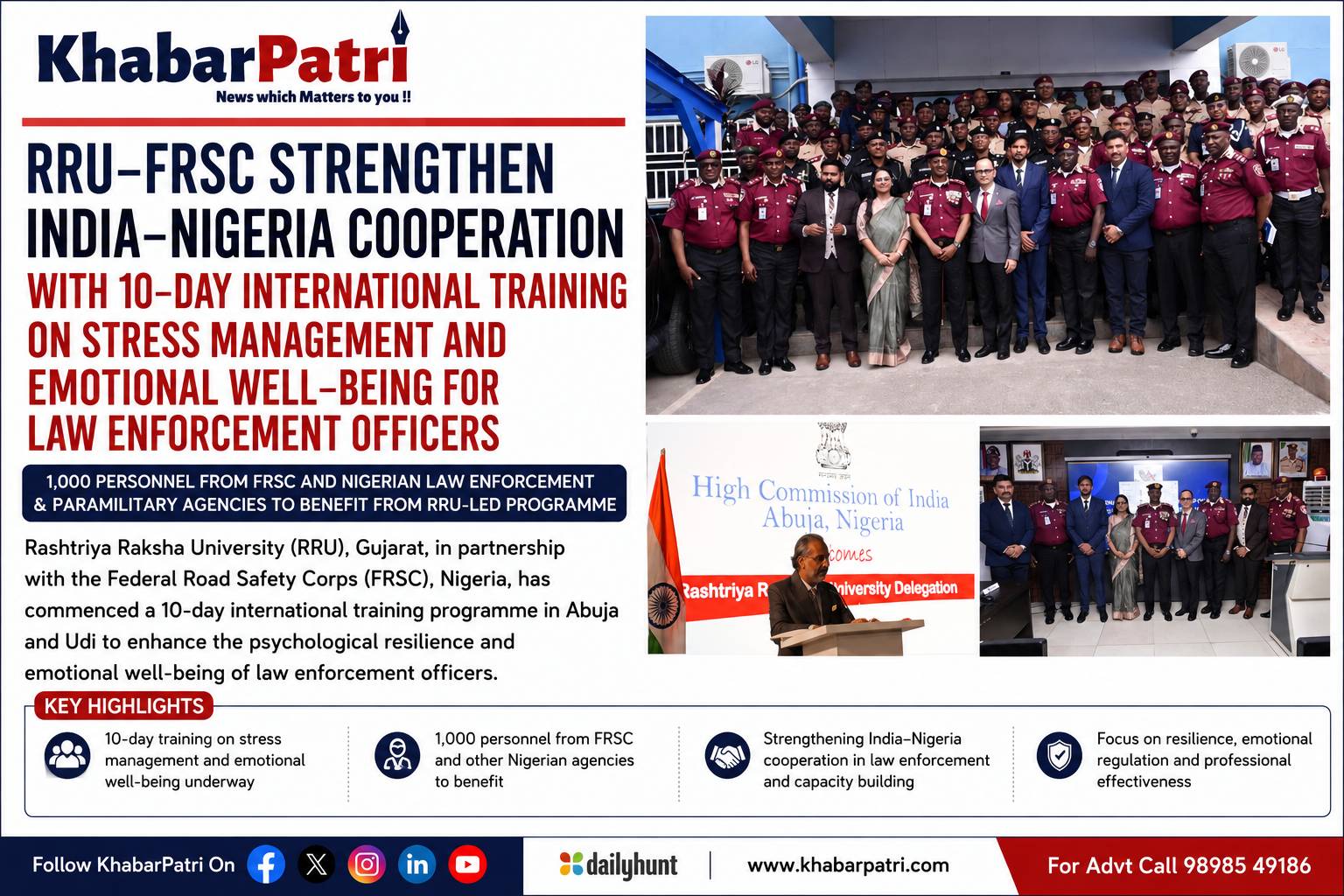
Abuja/Udi, Nigeria: Rashtriya Raksha University (RRU), Gujarat, India, in partnership with the Federal Road Safety Corps (FRSC), Nigeria, has commenced a 10-day international training programme on Stress Management and Emotional Well-being for Law Enforcement Officers, marking another step towards strengthening India–Nigeria cooperation in national security and law enforcement capacity building.
The programme is being conducted in Abuja and at the FRSC Academy, Udi, Enugu State, with a focus on strengthening psychological resilience, emotional well-being and professional effectiveness among personnel working in high-pressure operational environments.
Approximately 1,000 personnel from the FRSC and other Nigerian law enforcement and paramilitary agencies are expected to benefit from the programme. Participating agencies include the Nigeria Police Force, Nigeria Immigration Service, Nigeria Correctional Service, Nigeria Customs Service, Federal Fire Service and Nigeria Security and Civil Defence Corps (NSCDC).
The initiative reflects India’s continued commitment to capacity building, institutional strengthening and knowledge exchange with partner countries in the areas of national security, policing and public safety. RRU, an Institution of National Importance under the Ministry of Home Affairs, Government of India, continues to contribute to professional capability development across the security and law enforcement ecosystem.
The training covers practical competencies including stress management, emotional regulation, psychological resilience, self-management, behavioural awareness, peer support and effective coping mechanisms. These skills are particularly relevant for personnel routinely exposed to road traffic crashes, emergencies, disasters, security incidents, casualties and other critical operational situations.
Speaking at the inaugural programme, Shehu Mohammed, Corps Marshal, Federal Road Safety Corps, highlighted the importance of investing in the mental and emotional well-being of law enforcement personnel. He emphasised that sustainable effectiveness in modern law enforcement requires not only technical and operational competence but also psychological preparedness and resilience.
The programme was inaugurated on behalf of the Indian High Commissioner to Nigeria by Col. Manoj Singh, Defence Advisor, High Commission of India, Abuja. He highlighted the longstanding and multifaceted relationship between India and Nigeria and stressed the importance of translating bilateral ties into practical institutional cooperation and capacity-building initiatives.
He also noted the growing importance of psychological resilience in modern law enforcement and the value of sharing India’s institutional experience and expertise with Nigerian security and law enforcement agencies.
Representing Dr. Jasbirkaur Thadhani, Vice Chancellor of Rashtriya Raksha University, Dean, Academic, RRU, reaffirmed the University’s commitment to expanding international cooperation in law enforcement education, professional training, behavioural sciences and institutional capacity building. The programme builds on RRU’s broader international engagement in areas including security education, policing, criminology, behavioural sciences, forensic investigation and capacity building, while strengthening institutional engagement between RRU and Nigerian law enforcement agencies.
Indian Delegation
The Indian delegation comprises:
- Dr. Jasbirkaur Thadhani, Dean, Academics, Rashtriya Raksha University
- Mr. Arsh G., Campus Director, Rashtriya Raksha University, Puducherry
- Mr. Kalpesh Sharma, Head – Sports Training, Strength & Conditioning, Rashtriya Raksha University
- Mr. Chandrakant Yadav, Head & Section Officer, Atal Incubation Centre, Rashtriya Raksha University
The 10-day programme is expected to contribute to developing a more resilient, emotionally intelligent and professionally prepared law enforcement workforce, while further strengthening India–Nigeria cooperation in security and institutional capacity building. The initiative underscores India’s commitment to sharing institutional expertise and capabilities with international partners and advancing mutually beneficial cooperation in national security, policing and public safety.