

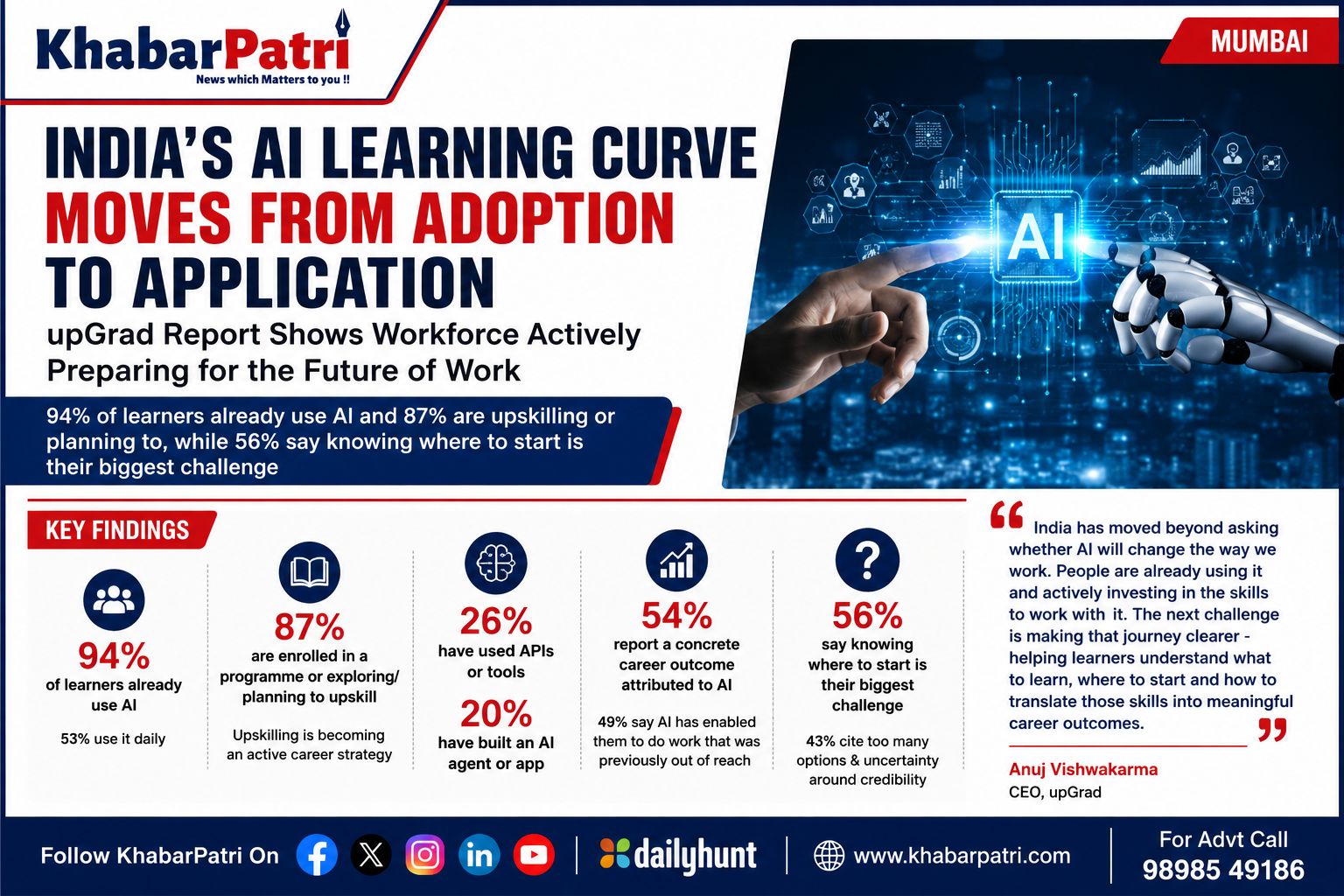
94% of learners already use AI, while 87% are actively upskilling or planning to build AI capabilities; 56% say knowing where to start remains their biggest challenge
Mumbai, August 13, 2026: As India marks its Independence Day, a new study by upGrad highlights a significant shift in how learners are approaching Artificial Intelligence (AI)—moving from early experimentation and everyday adoption towards actively building the skills required to work with AI.
The findings from Skill Shift – upGrad’s Annual Report on India’s AI Skilling, based on responses from 2,075 learners across career stages and cities in India, indicate that AI adoption has already become mainstream among the surveyed learner population. While 94% of respondents say they use AI, 87% are either currently enrolled in an AI-related programme or are exploring or planning to upskill.
The report also points to a broader democratisation of AI adoption across India. AI usage remains consistent across Tier 1, Tier 2 and Tier 3 cities, indicating that the shift towards AI is extending beyond major metropolitan centres and becoming an increasingly widespread part of the country’s evolving workforce landscape.
From AI Adoption to Career Impact
For many learners, AI is already translating into tangible professional outcomes. 54% of respondents report a concrete career outcome that they attribute to AI, including greater confidence at work, securing a new role or job, receiving a promotion, or generating freelance income.
Nearly half of the respondents (49%) also say AI has enabled them to undertake work that was previously beyond their capabilities, signalling the technology’s growing role in expanding individual productivity and professional possibilities.
The intensity of AI adoption also increases with professional experience. While 44% of early-stage learners report using AI daily, the figure rises to 62% among professionals with eight or more years of experience.
Upskilling Emerges as an Active Career Strategy
The findings suggest that AI learning is increasingly being viewed not simply as a supplementary skill, but as an important component of career development.
Overall, 87% of learners surveyed are either enrolled in a programme or exploring or planning to upskill in AI. Among professionals with eight or more years of experience, 31% spend three or more hours each week learning AI—more than twice the proportion among early-stage learners, at 15%.
This indicates that experienced professionals, in particular, are increasingly allocating dedicated time towards building AI capabilities as they navigate changing workplace expectations.
The Next Gap: Using AI vs. Building with AI
While AI awareness and usage are widespread, the report identifies a clear capability gap between using AI as a tool and building AI-enabled solutions.
Only 26% of respondents have connected AI to other tools or used an API, while approximately 20% have built an AI-powered automation, agent or application.
The data also indicates a relationship between structured learning and deeper AI application. Learners enrolled in an AI programme are 2.7 times more likely to have built an AI agent than those who are neither enrolled nor exploring AI learning opportunities—27% compared with 10%.
The findings suggest that India’s AI journey is entering its next phase: moving from experimentation and productivity use cases towards technical integration, automation, agentic workflows and AI-enabled application development.
Knowing Where to Start Remains the Biggest Barrier
Despite widespread adoption, learners continue to face challenges in navigating the rapidly expanding AI learning ecosystem.
56% of respondents identify knowing where to start as their biggest challenge when building AI skills. A further 43% cite the overwhelming number of available options and uncertainty about what is credible, while another 43% identify keeping pace with the rapid development of AI as a day-to-day challenge.
The findings underline an emerging need not merely for access to AI learning, but for clearer learning pathways that help individuals identify relevant skills, credible programmes and practical applications aligned with their career goals.
Key Findings at a Glance
- 94% of learners surveyed already use AI, with 53% using it daily.
- Daily AI usage rises from 44% among early-stage learners to 62% among professionals with 8+ years of experience.
- 87% are enrolled in an AI programme or are exploring or planning to upskill.
- 31% of professionals with 8+ years of experience spend three or more hours a week learning AI, compared with 15% of early-stage learners.
- 26% have connected AI to other tools or used an API.
- 20% have built an AI-powered automation, agent or application.
- Learners enrolled in a programme are 2.7 times more likely to have built an AI agent than those who are neither enrolled nor exploring—27% versus 10%.
- 56% say knowing where to start is their biggest AI-skilling challenge.
- 43% struggle with the number of available options and uncertainty around credibility.
- 43% identify keeping up with AI developments as a day-to-day challenge.
- 54% report a concrete career outcome they attribute to AI.
- 49% say AI has enabled them to perform work that was previously beyond their capabilities.
Commenting on the findings, Anuj Vishwakarma, CEO, upGrad, said, “India has moved beyond asking whether AI will change the way we work. People are already using it and actively investing in the skills to work with it. The next challenge is making that journey clearer—helping learners understand what to learn, where to start and how to translate those skills into meaningful career outcomes.”
As India celebrates Independence Day, the report offers a snapshot of a workforce increasingly taking ownership of its readiness for the future of work. The findings show that AI adoption and intent to upskill are already widespread among the surveyed learner community. The next opportunity lies in enabling more learners to progress from everyday AI usage and experimentation to deeper capabilities, technical application and meaningful career outcomes.