

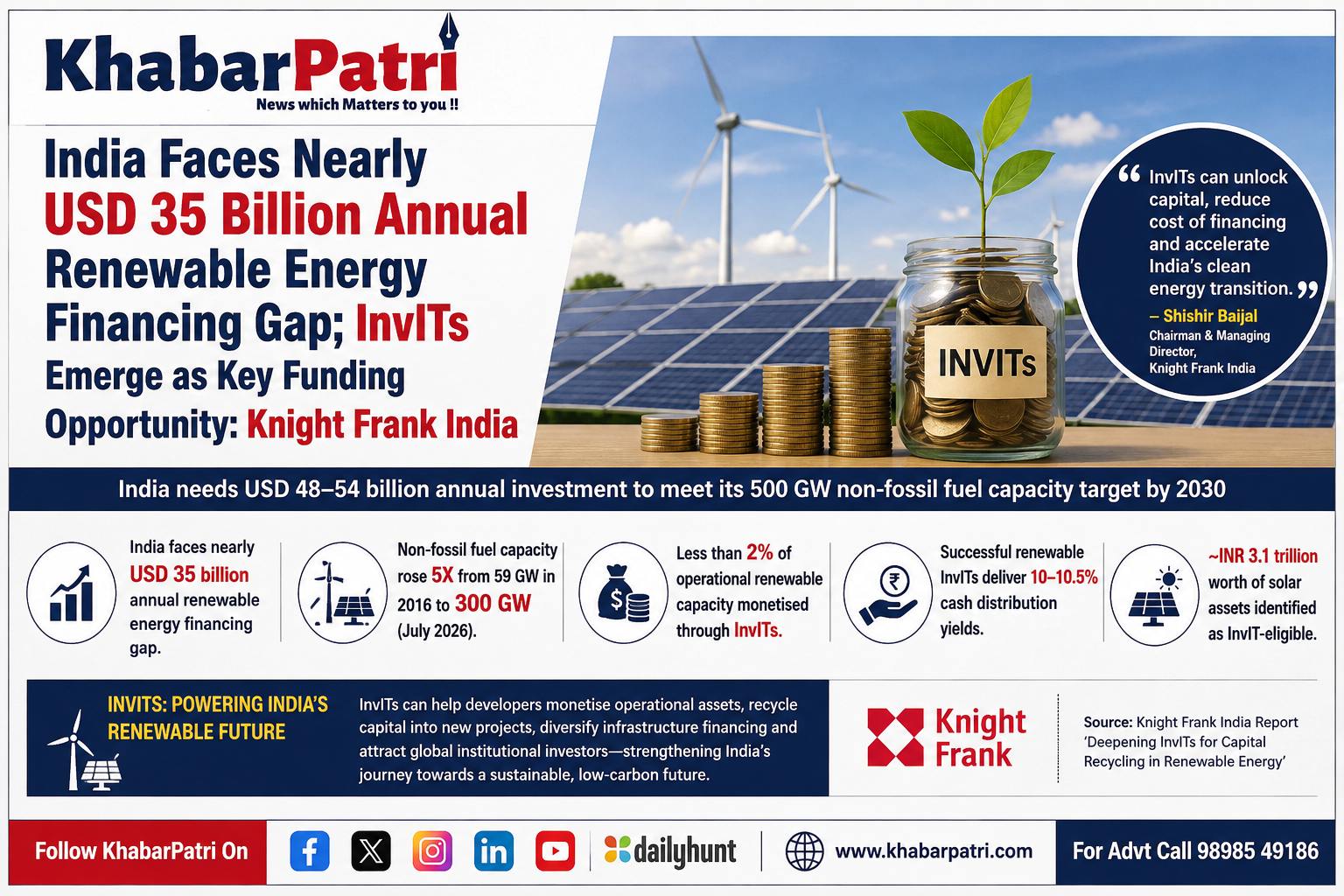
Mumbai: India faces an annual renewable energy financing gap of nearly USD 35 billion as the country accelerates efforts to achieve its target of 500 GW of non-fossil fuel energy capacity by 2030, according to the latest research study by Knight Frank India, titled Deepening InvITs for Capital Recycling in Renewable Energy.
India’s non-fossil fuel capacity, led by renewable energy, has increased fivefold over the past decade, rising from 59 GW in 2016 to 300 GW as of July 2026. With nearly 200 GW of additional capacity required over the next four years, the country will need to add around 50 GW annually.
This expansion is expected to require annual investments of approximately USD 48–54 billion, significantly higher than the current annual investment level of USD 13–18 billion. The resulting financing gap highlights the need for innovative capital mobilisation mechanisms to support India’s energy transition.
InvITs Can Help Bridge Renewable Energy Financing Gap
With private developers accounting for more than 90% of India’s renewable energy capacity, efficient capital recycling is becoming increasingly important. At the same time, financing renewable energy projects in India remains almost 80% more expensive than in mature international markets.
Against this backdrop, Infrastructure Investment Trusts (InvITs) could emerge as an important financing mechanism for the renewable energy sector. Knight Frank India’s research notes that less than 2% of India’s operational renewable energy capacity has so far been monetised through InvIT structures, pointing to significant untapped potential.
Shishir Baijal, International Partner, Chairman and Managing Director, Knight Frank India, said: “India’s renewable energy journey has now reached an inflection point where financing innovation will be as important as capacity addition. While the country has made remarkable progress in expanding renewable energy capacity, achieving the 500 GW target by 2030 will require significantly higher and more efficient capital deployment. InvITs can play a transformative role by unlocking capital embedded in operational renewable assets, reducing the cost of capital over time, and accelerating investments into the next generation of renewable energy, storage and transmission infrastructure. As operational renewable portfolios continue to mature, we expect InvITs to emerge as a mainstream financing avenue supporting India’s long-term energy transition.”
Renewable InvITs Offer Attractive Yield Potential
Operational renewable energy assets have demonstrated potential as income-generating infrastructure investments, supported by long-term power purchase agreements and relatively predictable cash flows.
According to the report, successful renewable InvIT platforms have consistently delivered cash distribution yields of around 10–10.5%, highlighting the potential of utility-scale renewable assets to provide long-term income visibility alongside growth opportunities. This could make renewable InvITs increasingly attractive to domestic and international institutional investors.
INR 3.1 Trillion of Solar Assets Identified as InvIT-Eligible
Solar energy has emerged as the primary growth driver of India’s renewable energy expansion. Installed solar capacity has increased nearly thirteen-fold since 2016 and now accounts for more than half of the country’s renewable energy capacity.
India’s current renewable energy mix comprises approximately 165 GW of solar, 58 GW of wind, 57 GW of hydro and 12 GW of bio-power capacity.
However, only around 3 GW of solar assets, equivalent to 2.3% of operational utility-scale solar assets, has been monetised through InvIT structures. Knight Frank India estimates that operational utility-scale solar assets worth approximately INR 3.1 trillion could be eligible for InvIT structures, highlighting the considerable scale of the opportunity.
InvITs Could Strengthen Capital Recycling Across Renewable Sector
Knight Frank India’s research suggests that InvITs can provide renewable energy developers with an avenue to monetise operational assets and redeploy capital into new generation capacity, energy storage and hybrid projects. As the renewable asset base matures, the growing pool of operational projects backed by long-term contracted cash flows could create a stronger pipeline of InvIT-ready opportunities.
A deeper renewable InvIT market could also diversify infrastructure financing beyond traditional bank lending by enabling greater participation from pension funds, insurance companies and global infrastructure investors.
Over time, greater use of InvIT structures could help ease financing constraints, improve asset valuations and strengthen investor confidence in India’s renewable energy sector, while supporting the country’s broader transition towards a low-carbon energy system.