

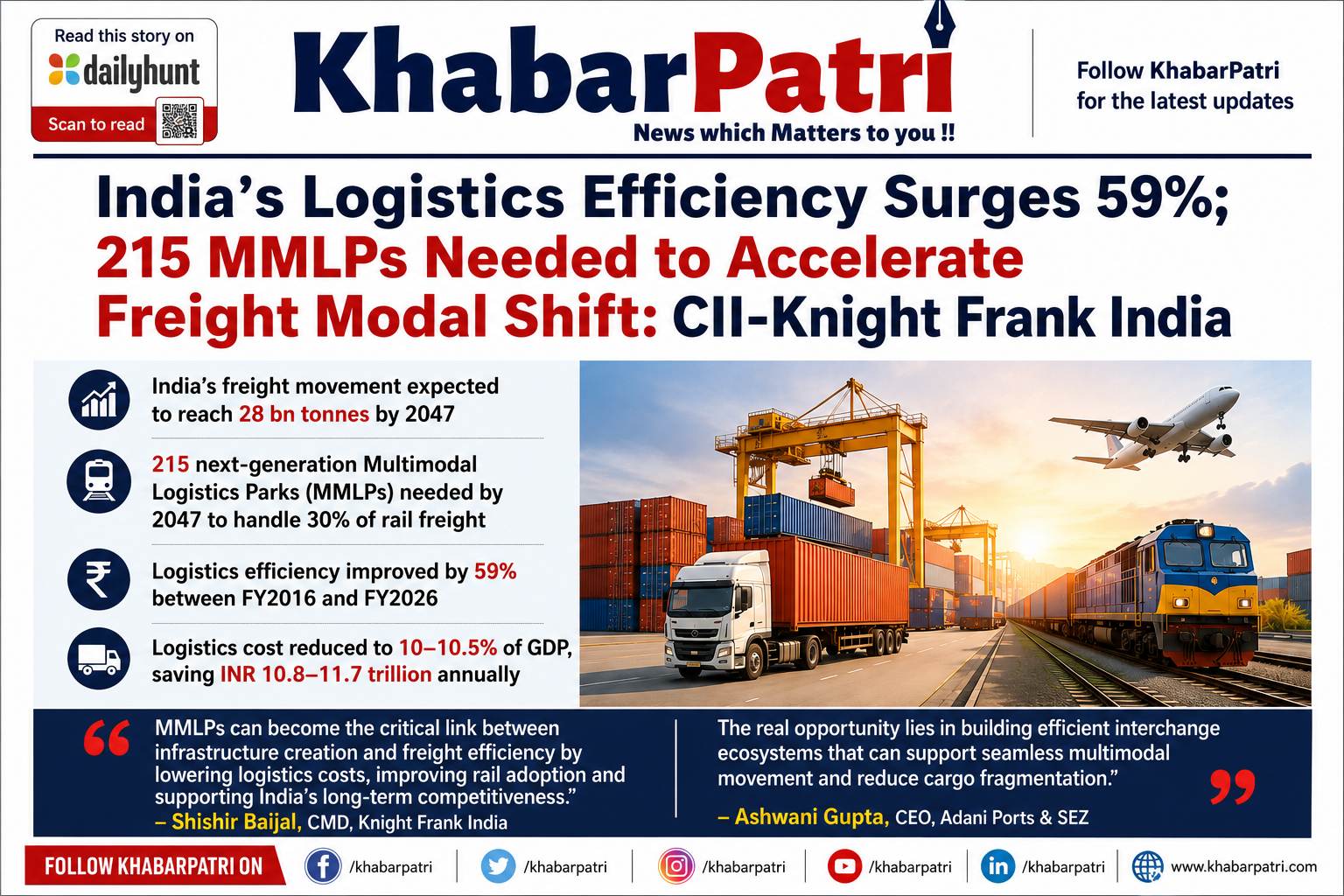
Mumbai: India will require nearly 215 next-generation Multimodal Logistics Parks (MMLPs) by 2047 to support the country’s rapidly expanding freight movement and accelerate the shift towards rail-based logistics, according to a new report released by the Confederation of Indian Industry (CII) and Knight Frank India.
The report, titled “Fast-Tracking MMLPs to Enable Modal Shift: India’s Multimodal Logistics Transformation,” projects that India’s annual freight movement will touch 28 billion tonnes by 2047. To meet the National Rail Plan target of increasing rail’s modal share in freight transportation to 45%, logistics infrastructure must undergo a major transformation, with MMLPs emerging as a key enabler.
According to the study, if MMLPs are expected to handle even 30% of rail freight by 2047, they will need to process over 3,162 million metric tonnes (MMT) of cargo annually. This would require approximately 215 large-format logistics parks equipped with integrated road, rail, and port connectivity.
Currently, India has around 30 operational MMLPs handling just 129 MMT of cargo annually—representing only about 2% of the nation’s total freight movement. An additional 45 logistics parks are under development, creating a pipeline of 75 facilities. However, experts believe the scale remains insufficient to meet future demand.
Commenting on the findings, Shishir Baijal, Chairman and Managing Director, Knight Frank India, said that India’s logistics sector has entered a scale-driven phase. He noted that while infrastructure investments have significantly strengthened transport networks over the past decade, the next stage of growth depends on integrating these assets efficiently.
The report highlights that India’s logistics efficiency has improved by 59% between FY2016 and FY2026, driven by massive investments in roads, railways, ports, and freight corridors. Annual capital expenditure in transport infrastructure increased from USD 10 billion in FY2016 to USD 57.6 billion in FY2026. These investments have contributed to lowering logistics costs to nearly 10–10.5% of GDP, generating annual savings estimated between INR 10.8 trillion and INR 11.7 trillion.
India has also improved its position in the World Bank’s Logistics Performance Index, rising from 54th place in 2014 to 38th in 2023, reflecting gains in infrastructure quality, customs efficiency, and logistics services.
Despite these improvements, road transport continues to dominate freight movement, accounting for nearly 70% of tonne-kilometre freight traffic, compared to 27.4% for rail and just 2.5% for waterways. The report argues that MMLPs can help address this imbalance by consolidating cargo, reducing transit times, and making rail freight commercially viable for non-bulk sectors.
According to the study, integrating Dedicated Freight Corridors (DFCs) with MMLP infrastructure could reduce door-to-door freight costs by as much as 43% compared to road-only transportation models. Cargo dwell times could also be reduced from as high as 152 hours at conventional facilities to as little as 2.5 to 8 hours through mechanised handling and digital workflows.
Ashwani Gupta, Chairman, CII National Committee on Ports and Shipping and Whole Time Director & CEO, Adani Ports and SEZ, said the focus must now shift from infrastructure creation to operational efficiency and network integration. He emphasized that MMLPs, supported by digital platforms such as ULIP, can strengthen supply chains, reduce logistics costs, and improve India’s competitiveness in manufacturing and exports.
The report recommends three key measures to accelerate multimodal logistics adoption: prioritising strategically important gateway MMLPs through stronger inter-ministerial coordination, leveraging freight volumes from Central Public Sector Enterprises (CPSEs) to support early-stage logistics parks, and strengthening first- and last-mile connectivity through feeder rail links and terminal infrastructure.
Industry experts believe that successful implementation of these measures will be crucial for India to build a globally competitive logistics ecosystem, support its manufacturing ambitions, and sustain long-term economic growth as freight volumes continue to rise over the next two decades.