

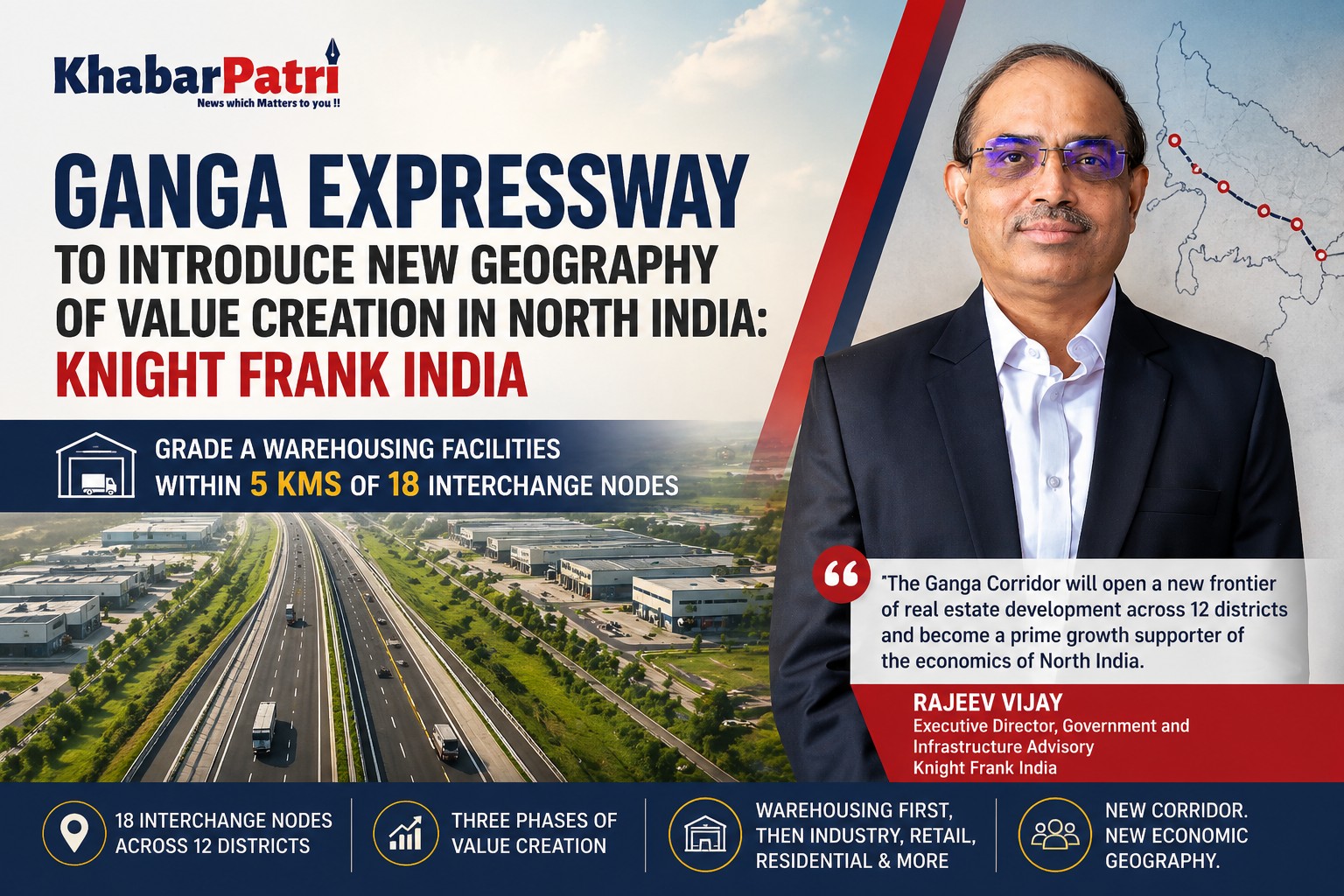
New Delhi: Leading international property consultancy Knight Frank India has highlighted that the upcoming Ganga Expressway is set to transform the real estate and economic landscape of Uttar Pradesh by introducing a new, corridor-driven model of value creation across 12 districts.
According to the firm, development along the expressway will unfold in three distinct concentric rings around 18 interchange nodes, with each phase unlocking opportunities across asset classes over different timelines.
In the first phase (0–3 years), Grade A warehousing and logistics facilities are expected to emerge rapidly within a 5 km radius of the interchange nodes, driven by improved connectivity and early price discovery.
The second phase (2–5 years) will witness industrial activation, increased residential demand in district towns, and expansion of retail, commercial offices, education, and healthcare infrastructure within a 5–20 km belt.
The third phase (5–10 years) will focus on long-term residential growth and agricultural land aggregation, attracting patient capital for large-scale industrial and infrastructure-led developments.
Emerging Growth Nodes Along the Corridor
Meerut is expected to evolve as a key residential hub due to spillover demand from NCR, while agro-processing clusters such as Pratapgarh (amla), Shahjahanpur (botanical products), and Hardoi (dairy) are likely to benefit from enhanced connectivity.
Cold chain infrastructure is anticipated to grow in Pratapgarh, Unnao, and Hapur, whereas districts like Amroha, Badaun, Shahjahanpur, and Hardoi are projected to see manufacturing-led expansion.
District Readiness and Investment Potential
Based on Knight Frank India’s proprietary District Readiness Index, Meerut and Prayagraj emerge as high-readiness districts, positioned to capture early gains. Meanwhile, districts such as Hardoi and Unnao fall under moderate readiness, indicating strong near-term industrial and economic potential supported by improving infrastructure.
Historically, Uttar Pradesh’s real estate growth has been concentrated in four cities—Lucknow, Ghaziabad, Noida, and Greater Noida. However, the Ganga Expressway introduces a fundamentally new development paradigm—node-driven, industrially anchored, and corridor-based, rather than capital-centric expansion.
A New Economic Geography
Commenting on the development, Rajeev Vijay, Executive Director, Government and Infrastructure Advisory at Knight Frank India, stated:
“The Ganga Corridor will open a new frontier of real estate development across 12 districts. For the first time, a high-speed economic corridor will seamlessly connect western UP’s manufacturing hubs with central UP’s agricultural regions and eastern UP’s education and pilgrimage centres—creating a powerful growth engine for North India.”
Strategic Significance
Uttar Pradesh currently accounts for nearly 60% of India’s operational expressway network, reinforcing its position as a key driver of infrastructure-led growth. The Ganga Expressway is expected to further accelerate this momentum by unlocking multi-sectoral investment opportunities and reshaping regional economic dynamics.