

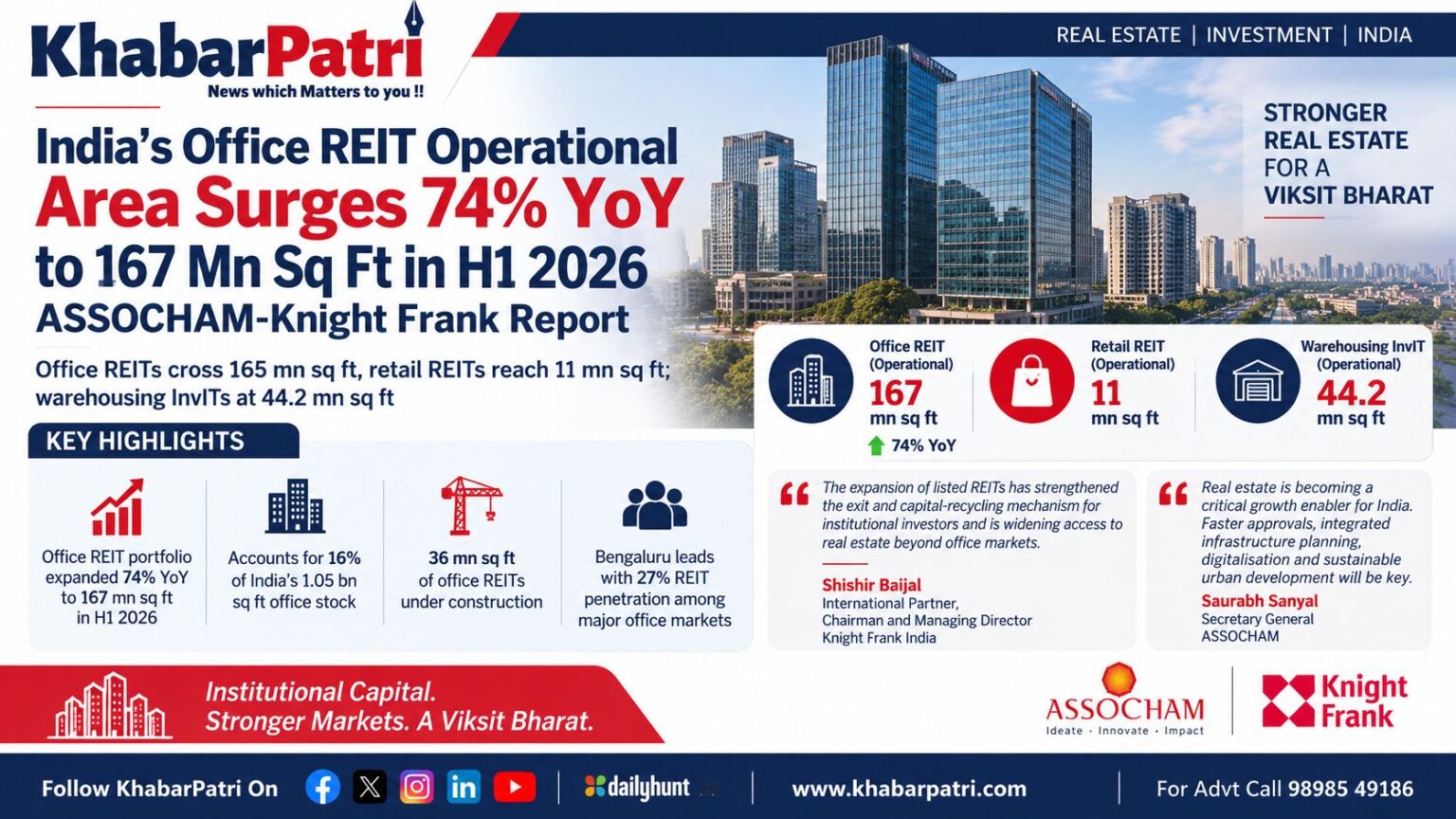
Office REITs cross 165 Mn sq ft, while retail REITs reach 11 Mn sq ft and warehousing InvITs stand at 44.2 Mn sq ft
Mumbai, September 8, 2026: India’s operational office REIT portfolio expanded 74% year-on-year (YoY) to 167 million sq ft in H1 2026, up from 95.8 million sq ft in H1 2025, according to the latest ASSOCHAM-Knight Frank India report, Building Viksit Bharat – Real Estate as a Catalyst for Growth. The sharp growth underlines the increasing role of REITs and InvITs in monetising, aggregating and recycling capital across real estate and infrastructure-linked assets.
The report states that the operational retail REIT portfolio stood at 11 million sq ft, while the warehousing InvIT portfolio reached 44.2 million sq ft as of June 2026. Roads and fibre continue to account for a significant share of the broader InvIT asset base, while warehousing is emerging as an increasingly important segment.
Office REITs Continue to Lead India’s REIT Market
Office remains the dominant segment of India’s REIT market, with the operational office REIT portfolio accounting for 16% of the country’s 1.05 billion sq ft office stock. The under-construction portfolio is equivalent to a further 19% of the existing operational REIT stock, indicating continued expansion of institutional ownership, although REIT penetration remains uneven across markets.
Bengaluru recorded the highest REIT penetration among major office markets, with 67.6 million sq ft of REIT-backed office stock representing 27% of the city’s office inventory. Hyderabad followed with 26.2 million sq ft, covering 20% of its office inventory, while Mumbai recorded 24.6 million sq ft, equivalent to 14% coverage.
NCR and Pune each recorded 11% REIT coverage, while Chennai and Kolkata stood at 10% each. Ahmedabad recorded the lowest penetration among the markets covered, at 1%.
36 Mn Sq Ft of Office REITs Under Construction
Listed office REIT platforms have a combined 36 million sq ft of office space under construction. Bengaluru accounts for the largest share at 16.3 million sq ft, followed by Mumbai at 4.6 million sq ft, Hyderabad at 3.9 million sq ft and Chennai at 3.8 million sq ft.
Institutional Real Estate Expands Beyond Office
Shishir Baijal, International Partner, Chairman and Managing Director, Knight Frank India, said the expansion of listed REITs has strengthened the exit and capital-recycling mechanism available to institutional real estate investors. He noted that stabilised assets can be aggregated into listed portfolios, enabling investors to monetise holdings while widening access to institutional real estate. The expansion of retail REITs is also extending institutional ownership beyond established office markets.
Saurabh Sanyal, Secretary General, ASSOCHAM, said real estate is increasingly becoming a critical growth enabler for India as the country moves towards Viksit Bharat. He highlighted the sector’s role in driving investment, employment and the expansion of manufacturing, logistics, technology and new-age businesses, while stressing the importance of faster approvals, integrated infrastructure planning, digitalisation and sustainable urban development.
Retail REITs Build a More Diverse Geographic Footprint
As of June 2026, the operational retail REIT portfolio stood at 11 million sq ft, comprising 10.7 million sq ft under Nexus Select Trust and 0.4 million sq ft under Brookfield India Real Estate Trust.
Retail REITs also have a more dispersed geographic footprint than office REITs. Around 4.6 million sq ft, or 45% of total retail REIT stock, is located outside the eight major office markets, across cities including Chandigarh, Bhubaneswar, Amritsar, Udaipur, Mangaluru, Mysuru, Indore and Ludhiana.
Warehousing Strengthens the InvIT Opportunity
The warehousing Infrastructure Investment Trust (InvIT) portfolio stood at 44.2 million sq ft as of June 2026, comprising 32.2 million sq ft of operational assets and a 12 million sq ft development pipeline.
The report notes that warehousing is a real estate-adjacent operating asset whose characteristics increasingly resemble infrastructure, supported by large-scale portfolios, recurring rental income and diversified occupier bases. Dedicated warehousing InvITs could further deepen institutional participation, diversify investment opportunities and strengthen India’s capital-market ecosystem.