

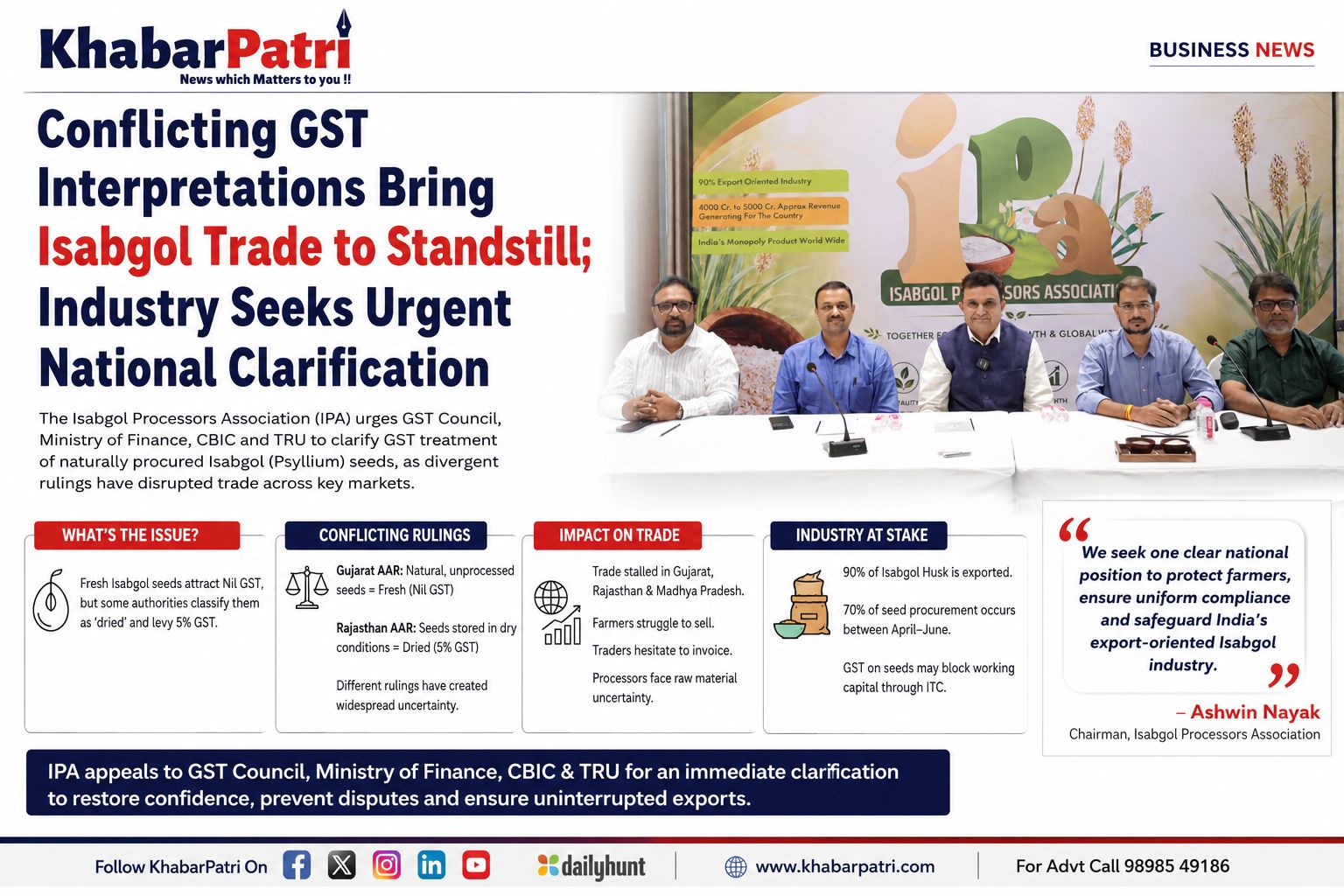
Ahmedabad : The Isabgol Processors Association (IPA) has urged the GST Council, Ministry of Finance, Central Board of Indirect Taxes and Customs (CBIC), and the Tax Research Unit (TRU) to issue an immediate nationwide clarification on the GST treatment of naturally procured Isabgol (Psyllium) seeds, following conflicting rulings by tax authorities in Gujarat and Rajasthan.
The Association says the divergent interpretations have created widespread uncertainty across India’s Isabgol trading and processing ecosystem, disrupting procurement, trade, and exports in one of the country’s most important agricultural commodity markets.
Gujarat and Rajasthan Offer Contradictory GST Views
The dispute centres on whether Isabgol seeds purchased directly from farmers in their natural, unprocessed condition should be classified as ‘fresh’ and exempt from GST (Nil GST) or treated as ‘dried’ and taxed at 5% GST.
The confusion stems from a CBIC FAQ which states that fresh Isabgol seeds attract Nil GST, while dried or frozen Isabgol seeds are taxable at 5% GST.
In GUJ/GAAR/R/2026/21 dated May 29, 2026, the Gujarat Authority for Advance Ruling (GAAR) ruled that Psyllium seeds procured directly from farmers through APMC auctions, without drying, freezing, crushing, or any other processing, qualify as fresh Isabgol seeds and are therefore exempt from GST.
However, the Rajasthan Authority for Advance Ruling (RAJ/AAR/2026-27/03) in the case of M/s Surendra Bucha held that Isabgol seeds supplied by APMC traders to processing units attract 5% GST, reasoning that the seeds acquire a dried character merely through storage in dry and ventilated conditions, even without intentional drying.
The Association says subsequent rulings in Rajasthan have reinforced the taxable interpretation, leading to inconsistent GST treatment across states.
Trade Across Major Isabgol Markets Severely Affected
According to the IPA, conflicting GST interpretations have disrupted the movement of Isabgol seeds across Gujarat, Rajasthan, and Madhya Pradesh, the country’s principal Isabgol-producing and trading regions.
Traders are reportedly reluctant to issue invoices due to fears of tax demands, interest, and penalties, while processors face uncertainty over raw material procurement. Farmers are also experiencing delays in selling their produce because of the prevailing ambiguity.
The impact is particularly visible in Unjha, India’s leading Isabgol trading hub, where industry stakeholders say trading activity has slowed significantly while awaiting a uniform GST position.
Export-Oriented Industry Faces Working Capital Pressure
Isabgol seeds are the primary raw material used to manufacture Isabgol Husk, a globally exported dietary fibre product.
The IPA stated that nearly 90% of India’s Isabgol Husk production is exported, while the remaining 10% is sold domestically with GST applicable on finished products. Since nearly 70% of annual seed procurement occurs between April and June, imposing GST on naturally procured seeds could result in substantial working capital blockage through input tax credit, particularly for exporters awaiting refunds.
Industry Calls for Uniform National Clarification
Mr. Ashwin Nayak, Chairman, Isabgol Processors Association, said the industry urgently requires a clear, uniform, and nationally applicable GST interpretation that can be consistently followed by farmers, traders, processors, and exporters across all states.
The Association has appealed to the GST Council, Ministry of Finance, CBIC, and TRU to clarify whether Isabgol seeds purchased from farmers in their natural condition and supplied to processing units without intentional or mechanical drying should continue to be treated as fresh agricultural produce exempt from GST.
The IPA believes an immediate clarification will restore confidence in the Isabgol market, ensure uniform GST compliance across India, prevent future tax disputes, protect farmers and traders, and support uninterrupted production and exports of Isabgol products.