

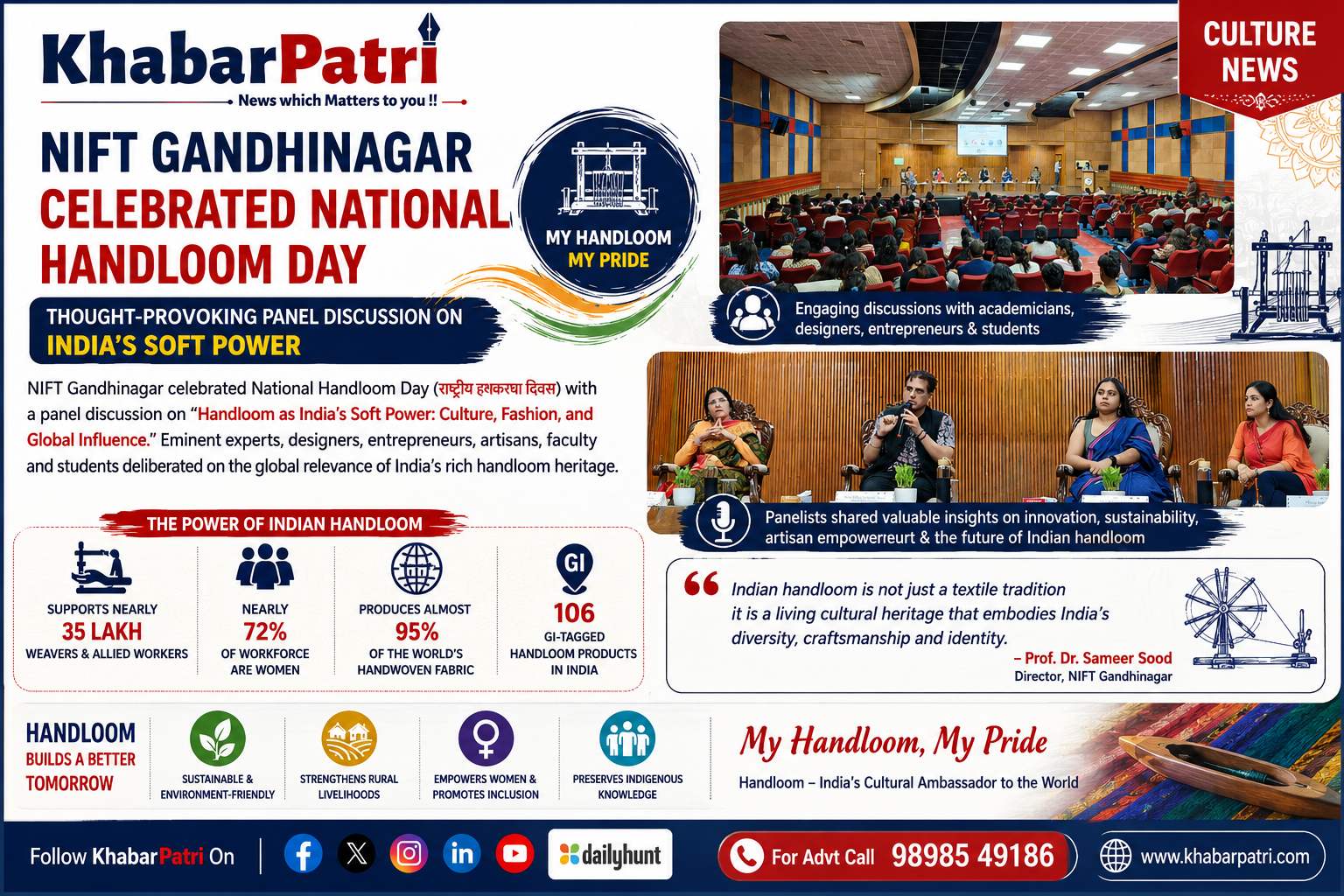
Gandhinagar : NIFT Gandhinagar celebrated National Handloom Day with a thought-provoking panel discussion on “Handloom as India’s Soft Power: Culture, Fashion, and Global Influence”, bringing together academicians, designers, textile artists, entrepreneurs, artisans, faculty members and students to examine the growing global significance of India’s handloom heritage.
The programme was organised under the guidance of Prof. Dr. Sameer Sood, Director, NIFT Gandhinagar, and focused on the role of Indian handloom in strengthening the country’s cultural identity, sustainable development and global influence.
The distinguished panel featured Prof. Dr. Reena Bhatia, Professor, Department of Clothing & Textiles, M.S. University, Baroda; Hansika Sharma, Textile Artist; Megha Das, Founder, Amounee; and Anand Shah, Founder, Lalan Palan. The discussion was moderated by Dr. Shubhangi Yadav, Associate Professor and Chairperson, Textile Design, NIFT Gandhinagar.
Handloom as a Symbol of India’s Cultural Identity
Addressing the gathering, Prof. Dr. Sameer Sood highlighted Indian handloom as an enduring representation of the country’s culture, creativity and civilisational values.
He noted that August 7 is observed as National Handloom Day to commemorate the launch of the Swadeshi Movement in 1905, which encouraged the use of indigenous products and played a significant role in India’s freedom movement.
According to Dr. Sood, the spirit of Swadeshi continues to resonate with contemporary national priorities, including Atmanirbhar Bharat, Ek Bharat Shreshtha Bharat, Brand Bharat and Viksit Bharat 2047.
He highlighted India’s vast handloom ecosystem, which supports nearly 35 lakh weavers and allied workers and accounts for almost 95% of the world’s handwoven fabric. He described the sector as a living cultural heritage that has preserved centuries-old craftsmanship while adapting to changing consumer preferences and design trends.
Sustainability and Women’s Economic Empowerment
Dr. Sood also emphasised the handloom sector’s contribution to economic growth, environmental sustainability and social inclusion.
Handloom production supports rural livelihoods while requiring significantly less fossil fuel and electricity compared with mechanised textile production. With women accounting for nearly 72% of the sector’s workforce, the industry also serves as an important avenue for women’s economic participation and empowerment.
Drawing parallels with contemporary global priorities such as resilience, cooperation, innovation and sustainability, Dr. Sood said these values have been embedded in India’s handloom ecosystem for generations.
He traced India’s handloom traditions back more than 5,000 years to the Indus Valley Civilisation, describing the sector as an example of resilience and community-led production, while its ability to incorporate evolving design sensibilities demonstrates innovation rooted in tradition.
GI Tags and Global Positioning
Highlighting India’s efforts to protect its textile heritage, Dr. Sood pointed to approximately 106 Geographical Indication (GI)-tagged handloom products. These registrations help protect traditional crafts, strengthen authenticity and enhance their commercial and international recognition.
He noted that handloom connects India’s diverse cultural traditions across nearly 500 districts, making it an important expression of the country’s cultural identity.
Reflecting on the historic importance of Khadi during India’s freedom struggle, Dr. Sood said handloom represented self-reliance and national pride then and continues to carry the same significance in the pursuit of an Atmanirbhar Bharat.
He urged students, designers and researchers at NIFT Gandhinagar to become ambassadors of Indian handloom and promote it as an instrument of cultural diplomacy, sustainable development and economic growth. “Fashion is incomplete without craft, and craft is deeply rooted in India’s handloom traditions,” he remarked, encouraging the NIFT fraternity to embrace the spirit of “My Handloom, My Pride.”
A Global Brand Opportunity for Indian Handloom
During the panel discussion, Prof. Dr. Reena Bhatia presented a vision of transforming Indian handloom into a globally recognised brand by 2047, coinciding with the centenary of India’s Independence.
She said Indian handloom has the potential to become one of the country’s strongest instruments of soft power, alongside Yoga, Ayurveda, Indian cuisine and Indian cinema.
Prof. Bhatia envisioned Indian handloom achieving global recognition comparable to the associations that Swiss watches, Italian leather and French luxury enjoy, while evolving from a traditional textile category into a preferred global lifestyle and fashion choice.
She highlighted the sector’s socio-economic significance, noting that it supports approximately 35 lakh weavers and allied workers, operates around 28 lakh looms, and has a workforce that is predominantly based in rural India.
She also pointed to the sector’s 106 GI-registered handloom textiles as a strong foundation for building authenticity, protecting heritage and developing global brands, particularly amid rising international demand for sustainable and ethically produced textiles.
Innovation Needed to Unlock Global Potential
While acknowledging the growing export potential of Indian handloom, Prof. Bhatia identified challenges including low artisan incomes, a declining workforce, limited participation among young people and restricted access to international markets.
She advocated a comprehensive approach combining heritage with innovation through design diversification, technology adoption, strategic branding, digital traceability, blockchain-based authentication, youth engagement, supportive public policies and international collaborations.
She envisioned India’s handloom traditions being digitally documented and positioned within international luxury and fashion markets through authentic collaborations. She emphasised that exporting Indian handloom means exporting not only a textile product but also India’s civilisation, culture and identity, with handloom having the potential to become one of the country’s key cultural ambassadors globally.
Strengthening India’s Textile Leadership
The interactive panel discussion witnessed active participation from students, faculty members, designers and industry stakeholders. Discussions explored the future of Indian handloom through the lenses of innovation, sustainability, artisan empowerment, technology and global fashion markets.
The programme reaffirmed NIFT Gandhinagar’s commitment to preserving India’s textile heritage while promoting design-led innovation, with a focus on strengthening India’s cultural and economic leadership in the global fashion ecosystem.