

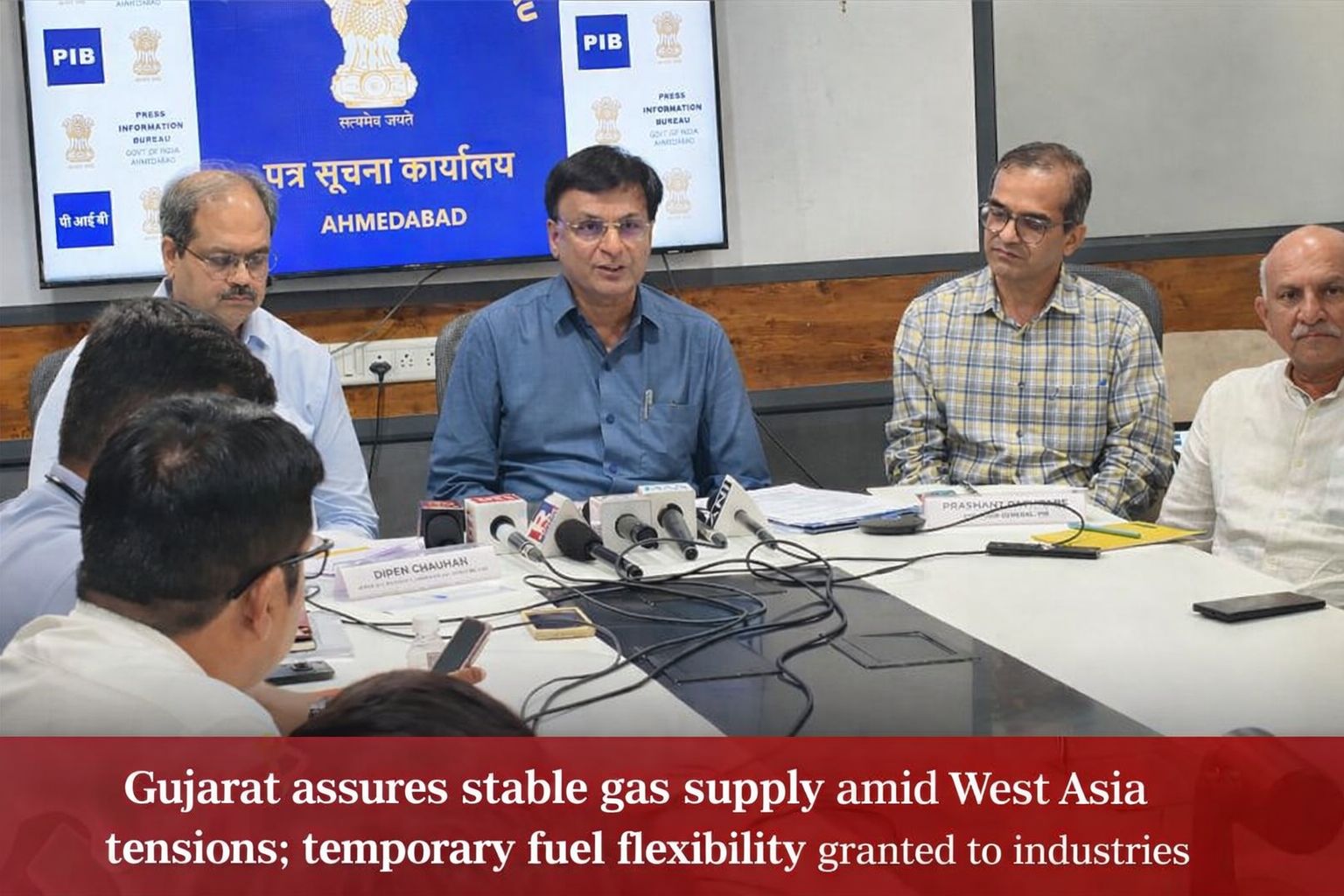
Ahmedabad: The Government of Gujarat, in coordination with the Centre, has assured uninterrupted availability of CNG, PNG, and other essential fuels across the state, even as geopolitical tensions in West Asia continue to impact global energy markets. At a state-level briefing held at the Press Information Bureau (PIB) in Ahmedabad, senior officials outlined a series of regulatory and supply-side interventions aimed at safeguarding industrial activity and consumer access to energy. A key announcement included the temporary removal of restrictions on solid alternative fuels for industrial and commercial units for three months, a move designed to ease pressure on gas supplies and provide operational flexibility to industries.
Limited Industrial Impact, No Major Layoffs
Officials indicated that the impact of the West Asia situation on Gujarat’s industrial ecosystem remains contained and manageable. Out of over 4.11 lakh registered industrial units, around 1,212 units have ceased operations primarily due to viability constraints, while 28,517 units are operating at reduced capacity.
Importantly, the state reported no major incidents of worker layoffs, reflecting resilience in employment levels despite external pressures.
To support workers, approximately 159 industrial community kitchens have been operationalised, benefiting nearly 50,000 workers.
Fuel Supply Prioritisation and Policy Measures
The government has implemented a calibrated strategy to balance industrial demand with essential consumption:
- Priority allocation of gas supply to critical sectors such as steel, textiles, chemicals, automobiles, and plastics
- Rationalised industrial gas supply adjustments to safeguard domestic LPG and PNG availability
- Extended LPG distribution hours to ensure faster and wider access
- Provision of 5 kg LPG cylinders for industrial workers
Additionally, industries have been temporarily permitted to use alternative fuels including coal, biomass, and waste-derived fuels to mitigate supply constraints.
Robust CGD Network and Rising PNG Adoption
Gujarat continues to lead India in City Gas Distribution (CGD) infrastructure, accounting for approximately 23% of the country’s domestic PNG connections.
The state has witnessed a sharp surge in adoption following recent policy push:
- Nearly 49,898 new PNG registrations and 26,909 conversions recorded in early 2026
- A 948% increase in domestic registrations following targeted campaigns
- Strong growth across commercial and essential service segments
Authorities have directed CGD entities to prioritise PNG connections for critical institutions, including hospitals, schools, hostels, and community kitchens, enhancing reliability in essential services.
Supply Chain Stability and Forward Outlook
Officials confirmed that no CNG stations have shut down since the onset of the crisis, with daily consumption at approximately 40 lakh kg supporting over 7.5 lakh vehicles.
Adequate LNG supplies are being maintained through terminals at Mundra and Dahej, with additional cargoes scheduled in the coming months, ensuring near-term supply stability.
Conclusion
With coordinated policy measures, diversified sourcing, and strong infrastructure, Gujarat has managed to contain the impact of global energy disruptions, ensuring continuity for both industry and consumers.
The state’s response highlights a proactive governance model focused on supply resilience, industrial stability, and clean energy transition, even amid evolving geopolitical uncertainties.