

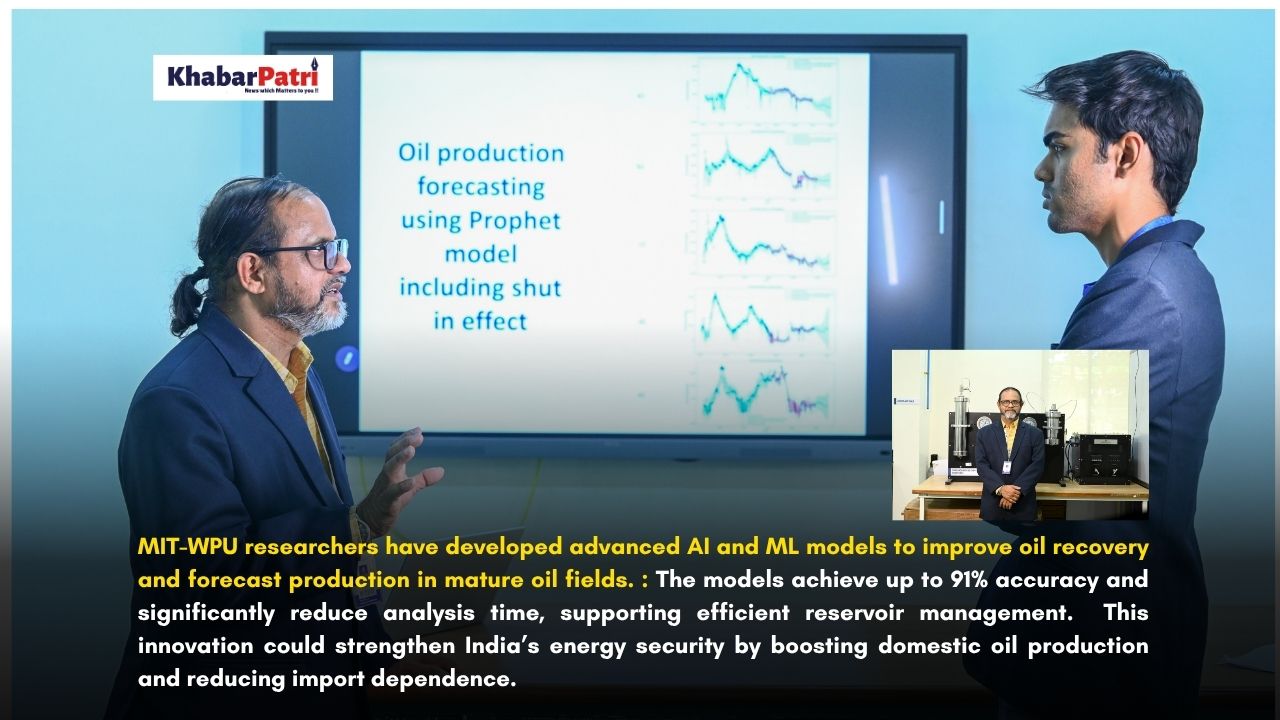
National: Amid rising volatility in global energy markets driven by geopolitical tensions and supply chain disruptions, researchers at MIT World Peace University (MIT-WPU), Pune, have developed advanced Artificial Intelligence (AI) and Machine Learning (ML) models to enhance oil recovery from mature reservoirs and improve production forecasting.
The breakthrough comes at a critical time when India’s growing economy is fueling increased energy demand. Oil and gas currently contribute nearly 32–37% of the nation’s total energy consumption, with crude oil imports costing approximately USD 161 billion, according to government estimates. Enhancing domestic production has thus emerged as a strategic priority.
The research team from MIT-WPU’s Department of Petroleum Engineering—the only dedicated upstream oil and gas academic department in Maharashtra—is leveraging AI to address complex reservoir management challenges.
A team led by Dr. Rajib Kumar Sinharay, along with Dr. Hrishikesh K. Chavan, has developed a machine learning model capable of identifying the most suitable Enhanced Oil Recovery (EOR) techniques for complex reservoirs. Trained on global oil field data, the model achieved an accuracy of 91%, significantly reducing evaluation time from months to just a few hours. The study has been published in Petroleum Science and Technology.
“Artificial intelligence has the potential to transform reservoir management in the oil and gas industry. Our work focuses on enabling data-driven decision-making for improved recovery and accurate production forecasting,” said Dr. Sinharay.
In another significant development, Prof. Samarth Patwardhan and Dr. Soumitra Nande have created a deep learning model that identifies carbonate reservoir rocks with 97% accuracy—similar to formations in Bombay High, India’s largest offshore oil field. Their research appeared in the Arabian Journal for Science and Engineering (2025).
Additionally, the MIT-WPU team has developed a machine learning model for forecasting oil production in mature fields, achieving 92% accuracy (R² score) using real-world data from Indian reservoirs. The findings were published in Physics of Fluids, highlighting its potential impact on investment planning and resource management.
The researchers have also designed an AI-based system to optimize oil production tubing, enabling more efficient extraction by determining ideal pipe sizes. This innovation was presented at an international conference and later published by Springer Nature, with a patent already secured. Currently, the team is working on identifying high-potential “sweet spots” in unconventional reservoirs and developing sustainable drilling fluids suited for extreme conditions.
These advancements underscore the increasing role of AI in transforming the oil and gas sector—enhancing efficiency, reducing dependency on imports, and strengthening India’s energy security in an uncertain global landscape.