

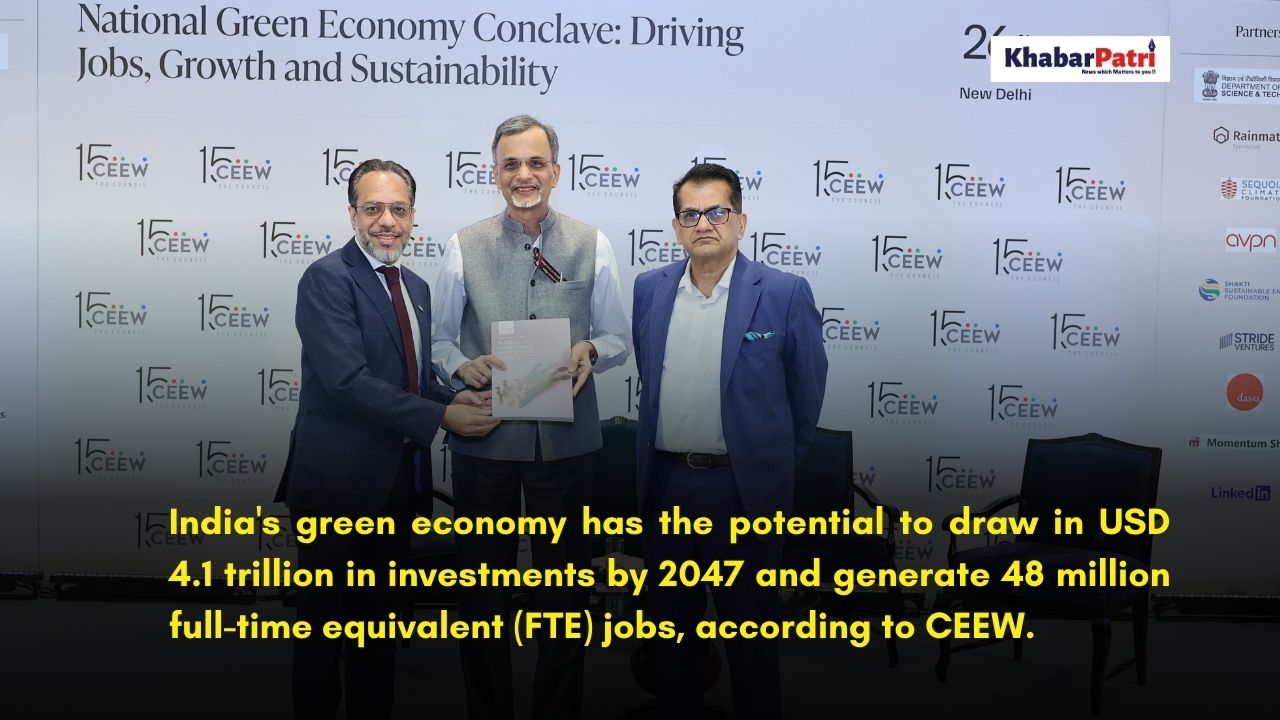
New Delhi : According to a new independent study released today by the Council on Energy, Environment and Water (CEEW), India has the potential to attract USD 4.1 trillion (INR 360 lakh crore) in cumulative green investments and generate 48 million (4.8 crore) full-time equivalent (FTE) jobs. The analysis also forecasts that by 2047, India could unlock an annual green market valued at USD 1.1 trillion (INR 97.7 lakh crore). This pioneering national assessment identifies 36 green value chains spanning energy transition, circular economy, bio-economy, and nature-based solutions, representing a significant green economic opportunity for India on its path to Viksit Bharat.
A green economy is often narrowly perceived as just solar panels and electric vehicles. However, this study reveals a much wider range of opportunities that encompass bio-based materials, agroforestry, green construction, sustainable tourism, circular manufacturing, waste-to-value industries, and nature-based livelihoods. Each of these sectors holds the potential to evolve into billion-dollar industries over the next twenty years, all while enhancing resource security and resilience. In Gujarat, significant strides have been made with nearly INR 900 crore invested in fisheries and seaweed under the Pradhan Mantri Matsya Sampada Yojana (PMMSY) over the past five years. Furthermore, the state has approved 14 companies to establish ethanol plants worth INR 3,300 crore, and has generated over 150,000 renewable energy jobs, positioning itself as one of India’s fastest-growing green industry ecosystems.
The dialogue also marked the establishment of the Green Economy Council (GEC), led by Shri Amitabh Kant and featuring other distinguished Indian leaders, including:

- Mr. Nithin Kamath (Zerodha)
- Mr. Deep Kalra (Makemytrip)
- Ms. Ruchi Kalra (Oxyzo Financial Services, OfBusiness)
- Ms. Shruti Shibulal (Tamara Leisure Experiences)
- Mr. Vineet Rai (Aavishkaar Group)
- Mr. Ishpreet Singh Gandhi (Stride Ventures)
- Prof. Ashok Jhunjhunwala (IIT Madras)
- Dr. Srivardhini K. Jha (NSRCEL, IIM Bangalore)
- Dr. Arunabha Ghosh (CEO, CEEW and Special Envoy for COP30 representing South Asia)
This council aims to assist India in identifying and harnessing emerging opportunities within the green economy.
Shri Jayant Sinha, President, Everstone Group & Eversource Capital, and Former Union Minister of State, GoI, said, “India’s green transition is fundamentally net positive: it can create millions of jobs, accelerate growth, improve public health and strengthen national security by shifting to domestic energy sources. The value chains identified in this CEEW study point to where this trillion dollar opportunity lies. Policy stability addressing bottlenecks like land, and usage of blended finance tools is now needed to de-risk investment. With a whole-of-government approach, India can mobilise the capital required to drive a green frontier development model.”
Speaking at the launch, Shri Amitabh Kant, former G20 Sherpa, former CEO, NITI Aayog, and Chairman, GEC, said, “As India moves beyond a USD 3 trillion economy, we cannot follow the development models of the West. With much of our infrastructure yet to be built, we have a unique chance to design cities, industries and supply chains around circularity, clean energy and the bioeconomy. Just as digital public infrastructure enabled India to leapfrog technologically—achieving in seven years what would have taken decades—we must now pole-vault into a green economy. While much of the world remains locked into legacy systems, a Viksit Bharat built on circular and resource-efficient value chains can define a new development pathway and set a global benchmark for green growth.”
Abhishek Jain, Director, Green Economy and Impact Innovations, CEEW, added, “Pursuing a green economy will not just create jobs and economic prosperity for India, it will also help us secure the fuels and resources of the future, making us Atmanirbhar. India today imports 87 per cent of its crude, which can be reduced to zero with electric vehicles, solar energy and next-generation bioethanol and biodiesel. We import 100 per cent of our lithium, nickel and cobalt, and even 93 per cent of copper ore—all of which can become zero-import with a circular economy. We are heavily dependent on fertiliser imports—all of our potash is imported, and 88 per cent of urea is directly or indirectly import-dependent. With bio-inputs for agriculture and the bioeconomy at large, we can secure our food and material needs. For India, green is not a choice: it is an imperative.”
Many sectors highlighted in these value chains have transitioned from niche markets: engineered bamboo is now widely used in flooring and construction materials, seaweed is gaining traction as a feedstock for bio-stimulants and biopolymers, and agroforestry is becoming part of state-level land-use planning. India must take advantage of these evolving opportunities on a larger scale.
According to CEEW analysis:
- ● Energy transition alone could generate 16.6 million FTE jobs and attract USD 3.79 trillion in investments across renewables, storage, distributed energy and clean mobility manufacturing. Electric mobility would be the single largest employer within the green economy, driving over 57 per cent of all energy-transition jobs.
- ● Bio-economy and nature-based solutions, anchored in India’s rural and peri-urban landscapes, could create 23 million jobs and unlock USD 415 billion in market value. The top job-generating value chains within this segment include chemical-free agriculture and bio-inputs (7.2 million FTE jobs), agroforestry and sustainable forest management (4.7 million FTE jobs), and wetland management (3.7 million FTE jobs)
- ● Circular economy could generate USD 132 billion in annual economic output and create 8.4 million FTE jobs across waste collection, recycling, repair, refurbishment and material recovery. Of these, 7.6 million FTE jobs would arise from waste-related activities, including roles in collection, sorting, aggregation, recycling operations, and last-mile resource recovery—sectors that could see improved wages and working conditions as systems formalise.

Together, these opportunities represent one of India’s largest untapped economic opportunities, with deep linkages to micro, small and medium enterprises (MSMEs), cooperatives and community enterprises.
Most of these represent net new green jobs, particularly in the bio-economy and rural nature-based sectors, while the energy-transition and circular-economy value chains combine new opportunities with transition roles from existing industries.
The CEEW study also lists significant challenges: lowering capital costs for early-stage sectors, improving supply chains for raw and recycled materials, strengthening R&D and innovation, building a technically skilled workforce, and establishing trusted product standards for emerging green technologies. Coordinated action across ministries, state governments, industries, finance and local institutions will be essential to integrate green value chains into mainstream economic planning.
The analysis emphasises that women’s participation is pivotal to India’s green economic transformation, and recommends gender-responsive skilling, safer mobility for remote worksites, improved wage structures and dedicated financial instruments for women-led green enterprises.
States are already beginning to act on building a green economy. Odisha, for instance, has constituted its own GEC and a committee of 16 state secretaries to embed green value chains into economic planning and drive green-led diversification, demonstrating how mission-oriented governance at the state level can accelerate India’s green economy transition.