

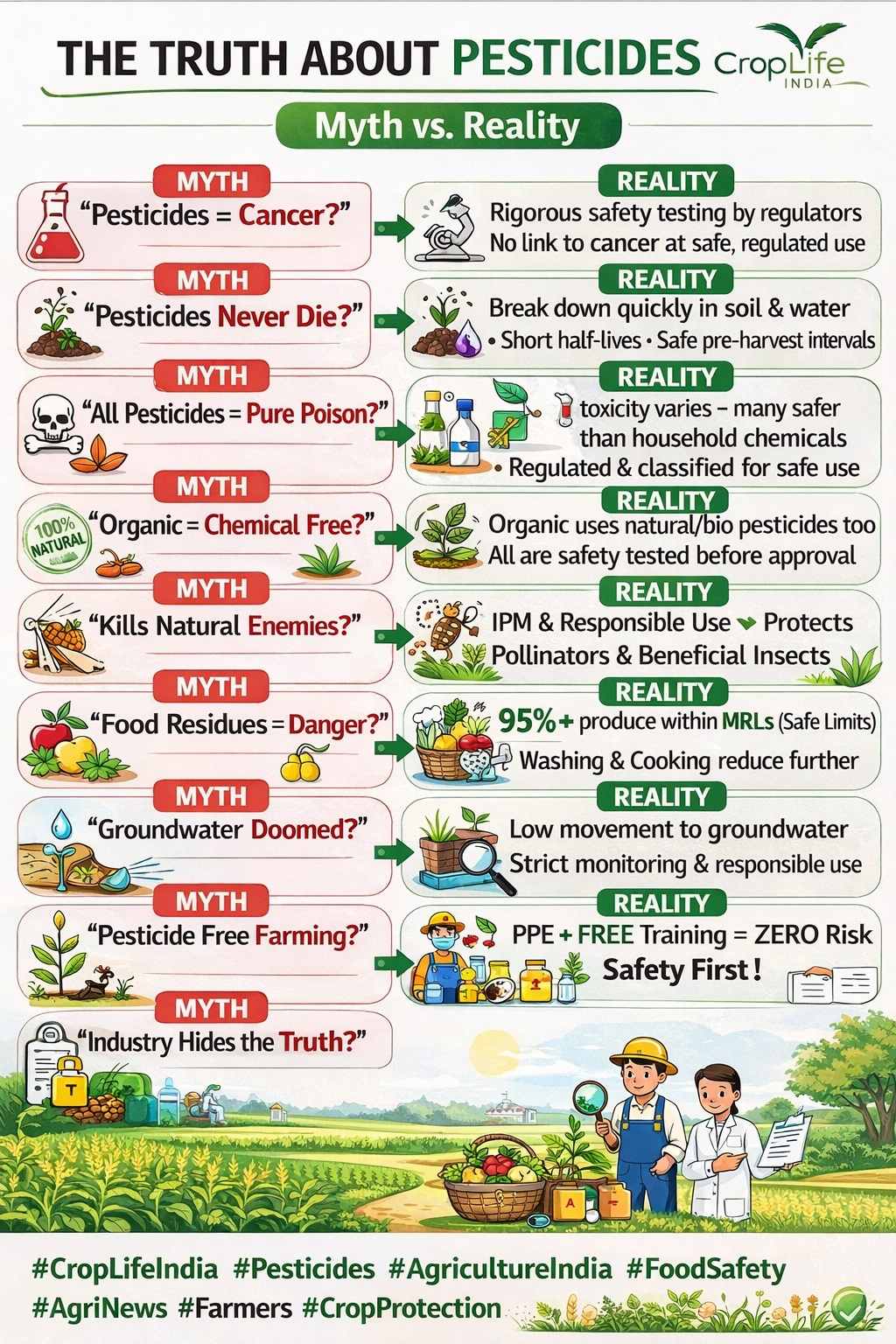
New Delhi: Amid rising public discourse on food safety, environmental risks, and pesticide use, CropLife India has released a comprehensive Myth-versus-Fact explainer aimed at addressing widespread misconceptions around crop protection practices in India.
The industry body emphasised the need for a more balanced, science-backed conversation, noting that misinformation could undermine both agricultural productivity and food security. According to Government of India estimates, pests and diseases account for 10–35% crop losses annually, with significantly higher damage during severe outbreaks. Despite these challenges, India remains among the lowest pesticide users globally, with application levels of 0.3–0.6 kg per hectare, compared to 2–4 kg in Europe, 13 kg in China, and over 10 kg in parts of East Asia.
“The objective of this explainer is to encourage a more balanced and evidence-based conversation around pesticides,” said Durgesh Chandra, Secretary General, CropLife India.
“Crop protection products play a critical role in safeguarding crops and ensuring stable yields. At the same time, the industry strongly advocates responsible use, stewardship, and strict adherence to India’s regulatory framework.”
Key Myths vs Facts Highlighted
• Myth: Pesticides cause cancer
Reality: All pesticides approved in India undergo rigorous evaluation by the Central Insecticides Board and Registration Committee (CIB&RC). When used as per label instructions and within prescribed limits, regulators have found no evidence of increased cancer risk for consumers.
• Myth: Pesticides persist indefinitely
Reality: Many modern pesticides are designed to degrade over time in soil and water. Their persistence varies depending on environmental conditions and product formulation.
• Myth: All pesticides are equally toxic
Reality: Toxicity levels differ significantly. Products are categorised based on safety profiles, with clear usage and handling guidelines provided on labels.
• Myth: Organic farming is chemical-free
Reality: Organic agriculture also uses approved pesticides, including naturally derived substances such as neem extracts and pyrethrum, all of which must meet safety standards.
• Myth: Pesticides harm beneficial insects
Reality: Integrated Pest Management (IPM) practices promote targeted use, combining biological controls and monitoring to minimise impact on pollinators and beneficial species.
• Myth: Residues in food are dangerous
Reality: India enforces Maximum Residue Limits (MRLs). Between 2022 and 2025, over 86,000 food samples were tested, with around 97% compliance. Washing, peeling, and cooking further reduce residue levels.
• Myth: Groundwater contamination is inevitable
Reality: Most pesticides bind to soil, limiting leaching. Contamination risks typically arise from misuse or over-application.
• Myth: Pesticide-free farming is viable at scale
Reality: Absence of crop protection tools can lead to 30–50% yield losses, directly impacting farmer incomes and national food security.
• Myth: Farmers are routinely poisoned
Reality: Proper training, protective equipment, and adherence to safety protocols significantly reduce exposure risks.
• Myth: The industry lacks transparency
Reality: Regulatory approval requires extensive data on health, environmental impact, and residues, all subject to government scrutiny.
Conclusion:
CropLife India reiterated that the future of Indian agriculture lies in science-led, regulated, and responsible crop protection practices, coupled with farmer education and sustainable farming techniques.