

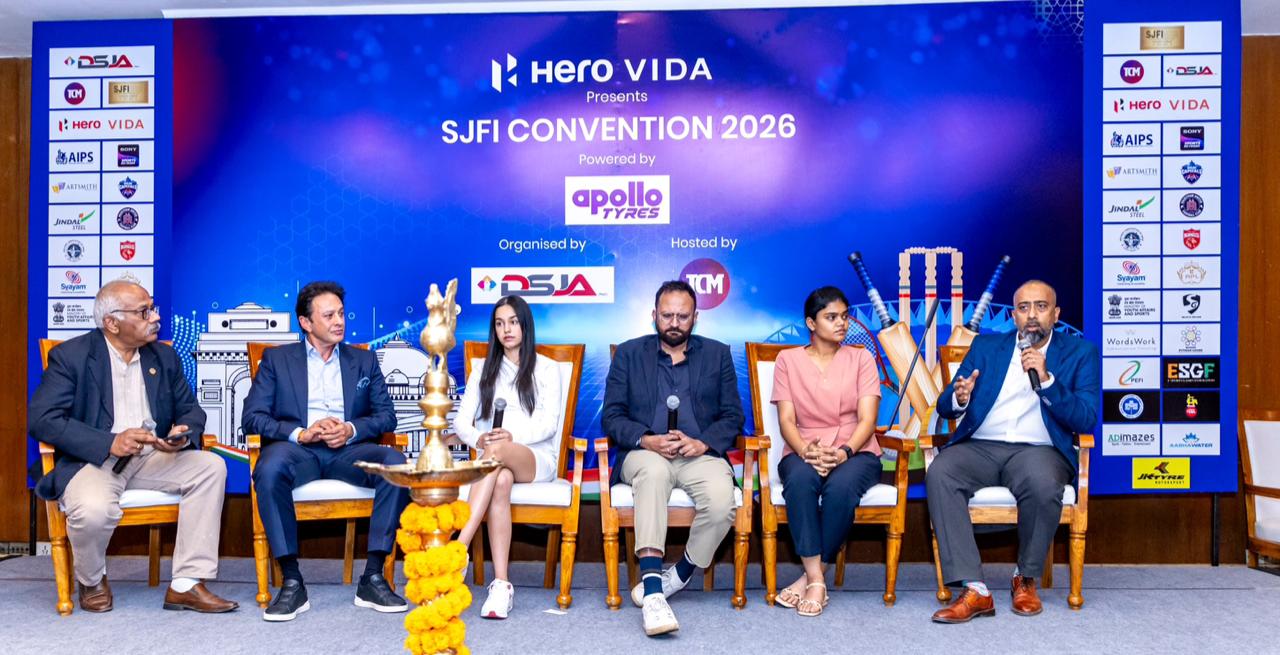
New Delhi : Calling for long-term planning to strengthen India’s global sporting footprint, ICC Chairman Jay Shah on Sunday urged stakeholders to begin preparations for the 2030–2036 global sporting cycle, emphasising the importance of collaboration between federations, corporates, athletes and the media.
Shah was speaking at the Grand Sports Conclave, held on Day 3 of the Golden Jubilee National Convention of the Sports Journalists Federation of India (SJFI) at the India Habitat Centre, New Delhi. The conclave was hosted by the Delhi Sports Journalist Association (DSJA) and brought together administrators, corporate leaders, broadcasters and members of the sports media to discuss the evolving landscape of Indian sport.
“While we focus on present competitions, we must also prepare for the future cycle — the 2030 Commonwealth Games, the 2032 Brisbane Olympics and the 2036 Olympics. Planning for these events has to begin well in advance if India wants to strengthen its global sporting footprint,” Shah said.
Reflecting on recent achievements, Shah described the 2019–2026 period as a golden phase for Indian cricket, highlighting the team’s success across formats and age groups.
“From 2019 to 2026 has been a golden period for Indian cricket. We have achieved success across formats and age groups, from U19 tournaments to major ICC competitions,” he said.
He also described India’s T20 World Cup triumph as a landmark moment and acknowledged the sports media for documenting the historic achievement.
“When India lifted the World Cup, it was a proud moment for the entire country. Many of you travelled with the team and captured those memories for millions of fans,” Shah added.
Corporates Driving Growth of Indian Sport
Speaking at the conclave, Sanjay Bhan, Executive Vice President, Hero MotoCorp, highlighted the increasing role of corporate participation in transforming India’s sporting ecosystem.
“Over the past decade we have witnessed a remarkable transformation in Indian sport. While cricket remains dominant, sports such as football, hockey and golf are gaining international recognition,” Bhan said.
He noted that corporate engagement today extends far beyond traditional sponsorship. “Corporates today are not just sponsors placing logos on jerseys. Many organisations are actively investing in the sports ecosystem — building leagues, nurturing grassroots talent and creating professional platforms for athletes,” he added.
Media Campaigns Building National Sporting Momentum
Neville Bastawalla, Head of Marketing and On-Air Promotions, Sony Sports Network, Sony Pictures Networks India, highlighted the powerful role of media campaigns in shaping sporting success and building national momentum around major events. Recalling Sony Sports’ ‘Mission 100’ campaign ahead of the Asian Games, Bastawalla credited the media fraternity for amplifying the message and helping build belief across the country.
“When we launched the campaign, many felt reaching 100 medals would be difficult, but the media backed the mission strongly and India eventually won 107 medals at the Asian Games,” he said. Bastawalla added that broadcasters play a crucial role in creating narratives and fan engagement around major sporting events.
Strong Governance Key to Attracting Corporate Investment
Remus D’Cruz, Global Head – Brand Strategy, Apollo Tyres, emphasised that transparency and stronger governance within sports federations are essential to attract greater corporate investment in Indian sport. “Sports media must hold a mirror to federations and call out wrongdoing where necessary. That accountability is important for the growth of sport,” D’Cruz said.
He added that improved governance at local and state levels would encourage more companies to invest in sports development and grassroots initiatives. The Grand Sports Conclave was a key highlight of the SJFI Golden Jubilee National Convention, serving as a platform for discussions on the future of Indian sport and the collective role of administrators, corporates, broadcasters and the media in strengthening the country’s sporting ecosystem.