

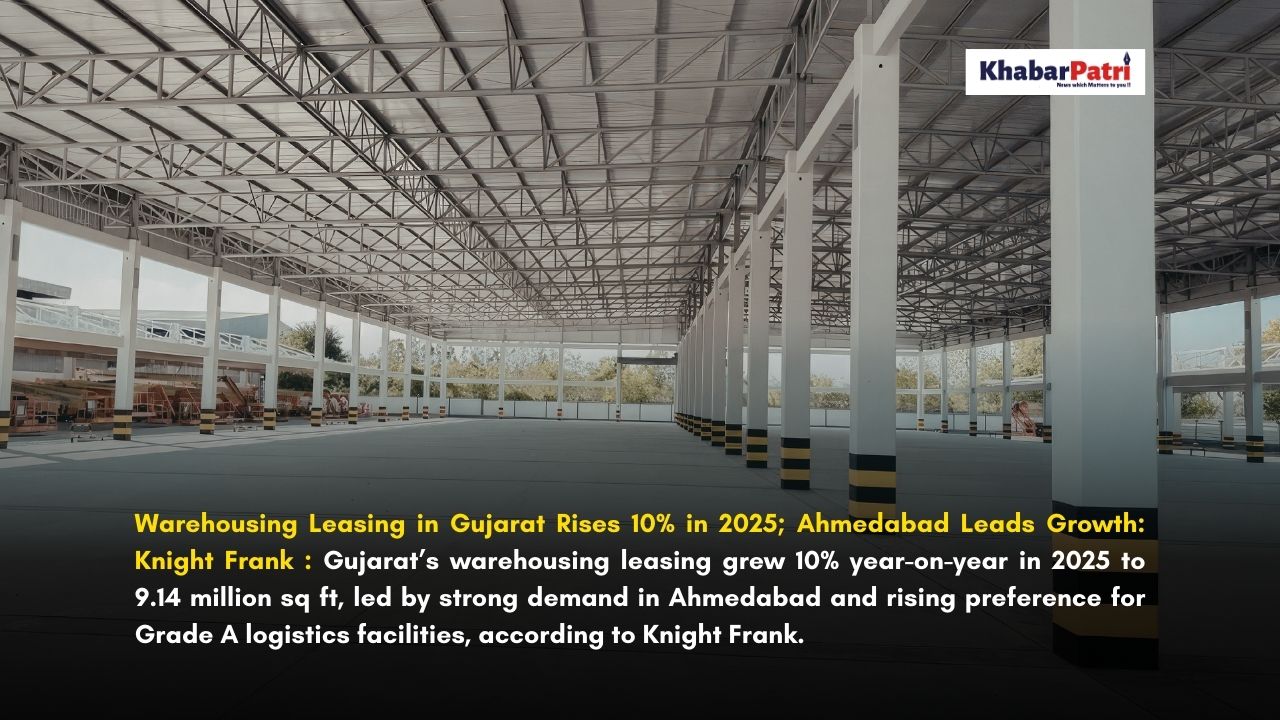
Ahmedabad drives demand with 6.4 mn sq ft transactions; manufacturing sector leads occupier activity while Grade A warehouses dominate leasing.
Ahmedabad: Gujarat’s warehousing sector recorded steady expansion in 2025, with leasing volumes rising 10% year-on-year to 9.14 million sq ft, up from 8.28 million sq ft in 2024, according to a report by Knight Frank India. The growth was driven by strong occupier demand across key logistics hubs including Ahmedabad, Surat, Vapi and Vadodara.
Ahmedabad emerged as the primary contributor to the state’s logistics activity, registering 6.4 million sq ft of warehousing transactions in 2025, an 11% increase from 5.8 million sq ft in 2024. The city ranked sixth among India’s major warehousing markets, highlighting its growing importance as a logistics and distribution hub.
The report noted that the manufacturing sector remained the largest demand driver, accounting for 46% of total leasing activity in Ahmedabad, followed by strong participation from third-party logistics (3PL), e-commerce and retail occupiers.
Shift towards Grade A warehousing
A key trend observed across the Gujarat warehousing landscape is the rising preference for Grade A facilities, reflecting the sector’s gradual formalisation. In Ahmedabad alone, Grade A warehouses accounted for 64% of total transactions in 2025, signalling occupiers’ increasing demand for modern, compliant and technology-enabled logistics infrastructure.
Among the city’s logistics clusters, the Aslali–Kheda belt remained the dominant warehousing hub, accounting for 43% of total leasing activity during the year. Located along the Mumbai–Ahmedabad Highway, the cluster continues to attract manufacturing, 3PL and e-commerce occupiers due to its strategic connectivity and established infrastructure.
The Changodar–Bagodara corridor has also gained momentum as an emerging logistics hotspot. Its share of transactions increased to 41% in 2025 from 35% a year earlier, supported by the development of modern logistics parks and improved connectivity. Notably, Grade A facilities accounted for 71% of transactions in this belt, reflecting occupiers’ preference for higher-quality warehousing assets.
Meanwhile, the Chhatral–Kadi–Vithalapur–Becharaji cluster contributed around 12% of transactions, while Sanand–Viramgam accounted for about 3% of total leasing activity. Interestingly, Grade A assets dominated leasing in these locations as well, representing 99% of transactions in Chhatral–Kadi–Vithalapur–Becharaji and 80% in Sanand–Viramgam.
Rental trends and land prices
Rental values across Ahmedabad’s warehousing clusters remained competitive but showed an upward trajectory in some pockets amid sustained demand and rising land prices.
Grade A warehouse rentals ranged between:
-
₹16–25 per sq ft per month in the Aslali–Kheda cluster
-
₹16–24 per sq ft in Changodar–Bagodara
-
₹16–21 per sq ft in the Vithalapur–Becharaji belt
-
₹18–27 per sq ft in the Sanand–Viramgam corridor
The report also observed that land prices appreciated across most clusters, reflecting continued occupier interest and growing investor confidence in Gujarat’s logistics ecosystem.
Surat strengthens position as secondary market
In the secondary warehousing market, Surat recorded leasing volumes of 1.48 million sq ft in 2025, ranking 10th among India’s 21 warehousing markets.
Warehousing activity in the city is largely concentrated along NH-48, which forms part of the Golden Quadrilateral corridor, offering strong connectivity to Ahmedabad and Vadodara.
The Kosamba–Palsana belt dominated leasing activity, accounting for 94% of total transactions, with Grade A warehouses making up nearly 80% of leased space. The Palsana–Sachin corridor, supported by improving connectivity and proximity to the city, contributed the remaining 6% of transactions and has increasingly attracted 3PL operators.
Rental values in Surat’s logistics clusters remained relatively higher compared with Ahmedabad. Grade A rentals ranged between:
-
₹20–28 per sq ft per month in the Kosamba–Palsana belt
-
₹22–28 per sq ft in the Palsana–Sachin corridor
-
₹22–26 per sq ft in the Ichhapore–Hazira cluster
The Ichhapore–Hazira belt, located near Hazira Port, remains largely industrial in character with warehousing developments catering primarily to manufacturing and port-linked logistics operations.
Vapi and Vadodara see strong momentum
Other industrial centres in Gujarat also witnessed notable growth. Vapi recorded a sharp 50% increase in warehousing leasing volumes, reaching 0.63 million sq ft in 2025, with demand largely concentrated in the Vapi–Bhilad belt. Grade A rentals in this cluster ranged between ₹20–27 per sq ft per month.
Vadodara also posted strong growth, with leasing volumes rising 27% year-on-year to 0.59 million sq ft. However, the market continues to face a supply shortage, as most developments remain built-to-suit projects, limiting the availability of ready speculative inventory.
The Savli–Jarod–Halol corridor, which has emerged as a prominent automotive manufacturing hub, accounted for 93% of Vadodara’s warehousing transactions. The cluster hosts several large industrial occupiers including JSW MG Motor, Hero MotoCorp and JCB, and has been designated as a Special Investment Region (SIR) under the Gujarat government’s SIR Act.
Grade A warehouse rentals in Vadodara ranged between:
-
₹20–26 per sq ft in the Savli–Jarod–Halol belt
-
₹23–28 per sq ft in the Padamala–Ranoli corridor
-
₹22–30 per sq ft in Makarpura–Karjan
Outlook for Gujarat’s logistics market
According to Knight Frank, Gujarat’s logistics and industrial real estate market is poised for sustained growth, supported by strong manufacturing activity, policy support and infrastructure development.
“Gujarat’s well-established industrial base across chemicals, textiles, pharmaceuticals and food processing — along with emerging sectors such as semiconductors, renewables and electronics — positions the state strongly to benefit from supply chain expansion and logistics formalisation,” said Rumit Parikh, Branch Head (Ahmedabad) and Senior Director – Occupier Strategy and Solutions, Industrial & Logistics, Knight Frank India.
He added that infrastructure projects such as the Delhi–Mumbai Industrial Corridor (DMIC) and the Dedicated Freight Corridor (DFC), along with the state’s strong port connectivity, are expected to further strengthen Gujarat’s position as a key warehousing and distribution hub in western India.