

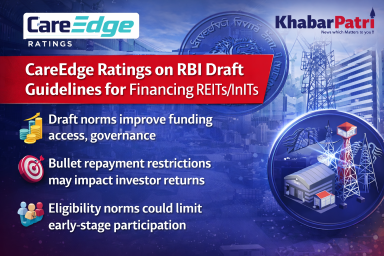
Mumbai, February 2026: The Reserve Bank of India (RBI) has issued the Draft Second Amendment Directions, 2026 for lending by commercial banks to Real Estate Investment Trusts (REITs) and Infrastructure Investment Trusts (InvITs). CareEdge Ratings has assessed the potential implications of the proposed framework, highlighting both structural benefits and emerging considerations for the sector.
Ms. Rajashree Murkute, Senior Director, CareEdge Ratings, stated that the RBI’s draft framework permitting commercial banks to extend credit to listed REITs is a significant step toward improving funding access for the sector at more competitive rates. She noted that the move is also expected to help banks diversify into stable, income-backed credit exposures.
She further emphasized that the proposal to introduce a comprehensive REIT/InvIT Lending Policy — covering appraisal and underwriting standards, DSCR benchmarks, internal single borrower and portfolio exposure limits, along with monitoring and covenant mechanisms — will support stronger governance and risk management practices across the ecosystem.
Commenting on structural safeguards, Ms. Murkute said ,the restriction on debt structures involving bullet or ballooning principal repayments is a welcome measure for InvITs with underlying assets operating under fixed-term concessions, as it helps mitigate refinancing risks. However, she cautioned that such restrictions could affect investor returns (IRR), particularly for REITs and InvITs with long-tenor or perpetual asset classes such as warehousing, transmission towers, and telecom towers.
Mr. Maulesh Desai, Director, CareEdge Ratings, observed that the stringent eligibility criteria — including the requirement of a minimum three-year operational track record for REITs and InvITs seeking bank funding — may limit bank participation during the early stages of these investment vehicles, despite many demonstrating strong creditworthiness.
As of March 31, 2025, the total debt across InvITs and their SPVs stood at approximately ₹2.81 lakh crore, with banks accounting for nearly 60% of the exposure, underscoring the critical role of banking sector participation in the continued growth and stability of the InvIT ecosystem. In this context, CareEdge Ratings noted that the evolution of the final policy framework will remain an important monitorable for the sector.