

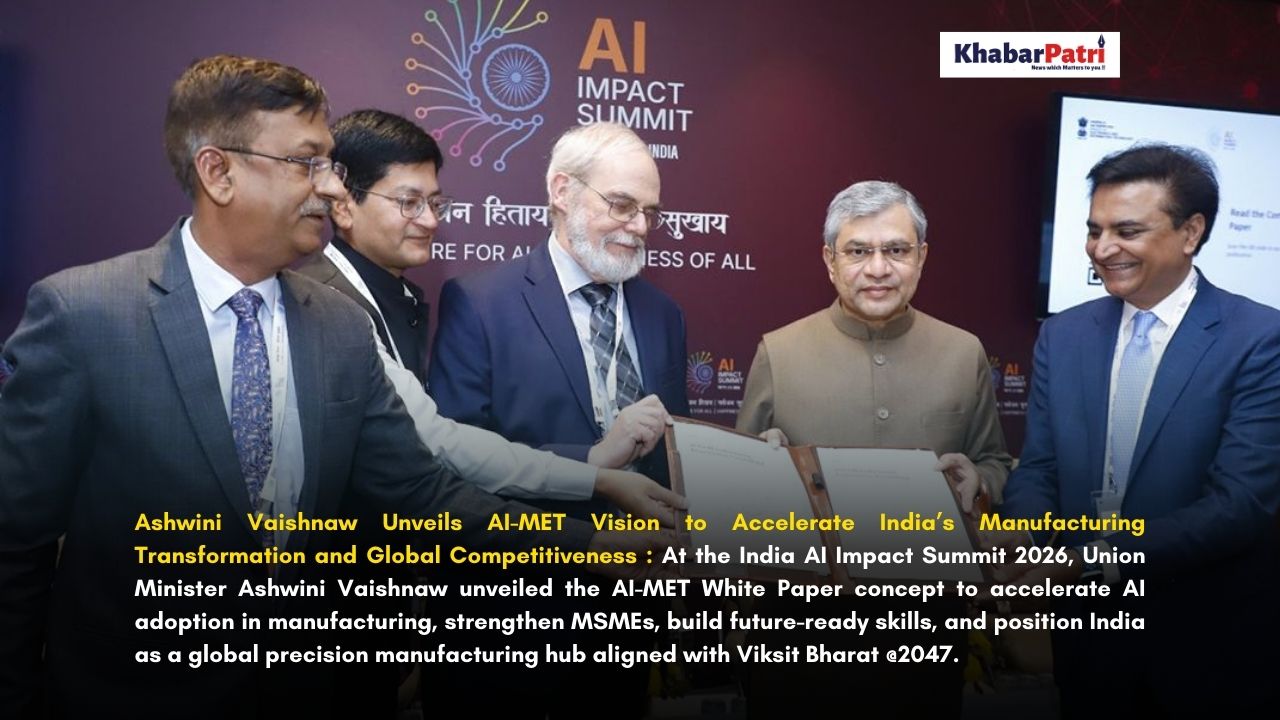
New Delhi : In a strategic push to accelerate India’s transition toward advanced manufacturing, Union Minister for Electronics and Information Technology Ashwini Vaishnaw outlined the country’s Artificial Intelligence priorities for the Manufacturing Engineering Technology (MET) ecosystem at the India AI Impact Summit 2026. The high-level convening brought together global academicians, industry leaders, policymakers, and technology experts to chart a collaborative roadmap for embedding AI across India’s manufacturing value chains.
During the event, the Minister unveiled the White Paper Concept on “AI for Manufacturing Engineering Technology (AI-MET)”, a strategic framework aimed at enabling responsible, scalable, and industry-wide AI adoption. The framework focuses on enhancing productivity, improving global competitiveness, strengthening sustainability, and preparing India’s workforce for next-generation industrial transformation.
The convening, curated by NAMTECH under the leadership of the Ministry of Electronics and Information Technology (MeitY), featured participation from leading institutions including MIT and IIT Madras, alongside senior industry executives from Microsoft India, Cisco India, Rockwell Automation, Palo Alto Networks, Dell Technologies, Intel, Tata Electronics, Hitachi India, and PayPal.
Speaking at the summit, Ashwini Vaishnaw described Artificial Intelligence as a foundational pillar in India’s journey toward Viksit Bharat @2047, emphasizing the need to integrate AI deeply into manufacturing systems to unlock productivity, innovation, and entrepreneurship. He highlighted the importance of building an inclusive AI ecosystem that empowers enterprises and MSMEs while strengthening India’s precision manufacturing capabilities through advanced talent development.
Industry and academic leaders underscored that the true impact of AI will be realized through large-scale deployment across shop-floor operations, industrial automation systems, and engineering value chains. They emphasized targeted skilling, application-oriented learning, and deeper collaboration between academia and industry to prepare a future-ready workforce capable of deploying AI responsibly and effectively.
Cybersecurity and secure operational technology infrastructure also emerged as critical priorities as AI becomes integral to modern manufacturing ecosystems. Experts stressed the need for enterprise-grade network security and stronger digital resilience to support large-scale AI integration. The summit builds on momentum generated by the Industry-Academia Roundtable held in May 2025 and advances the vision of establishing a Manufacturing Engineering Technology (MET) Platform. The platform aims to bring together industry, academia, and government under a shared governance model to drive industrial transformation, accelerate decarbonization, and position manufacturing at the core of India’s growth strategy.
With the launch of the AI-MET White Paper concept, India signals a decisive shift from AI capability development to real-world industrial deployment—strengthening its ambition to emerge as a globally competitive, technology-driven manufacturing powerhouse.