

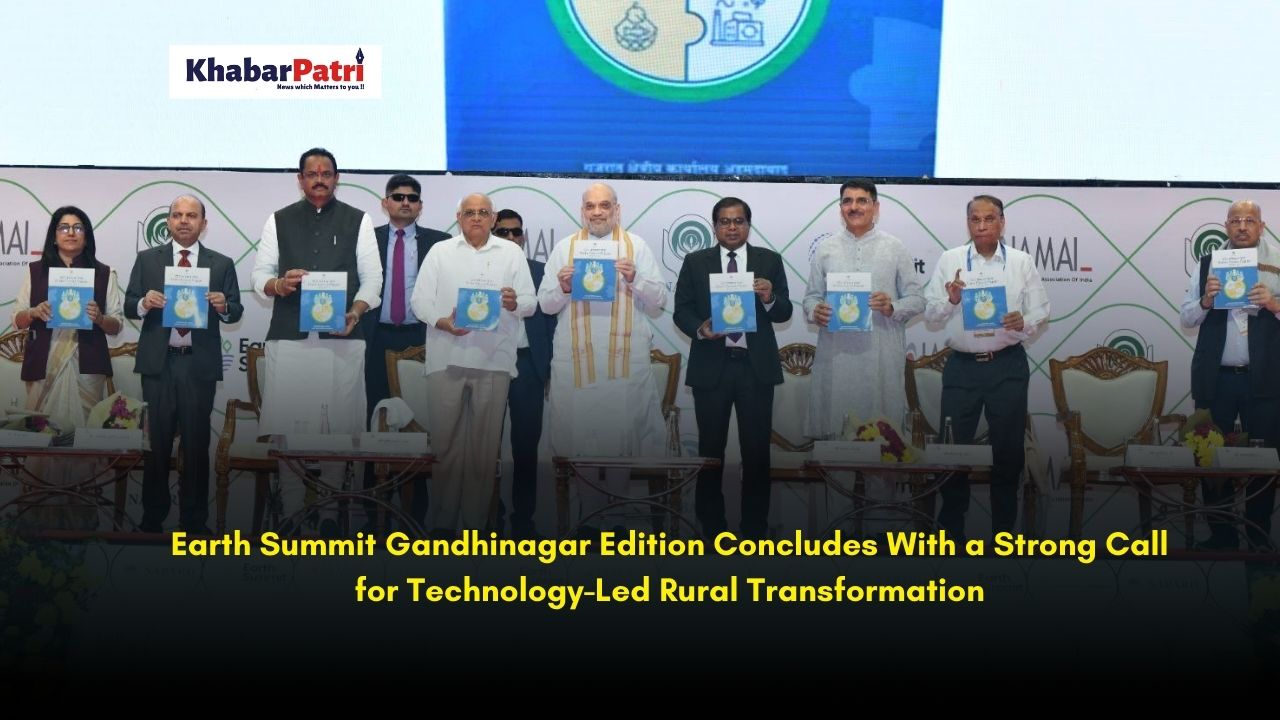
Gandhinagar : The two-day Gandhinagar edition of the Earth Summit 2025–26, jointly organised by the National Bank for Agriculture and Rural Development (NABARD) and the Internet & Mobile Association of India (IAMAI), concluded today at the Mahatma Mandir Convention & Exhibition Centre.
Centred on the theme ‘Empowering Rural Innovation for Global Change’, the Summit brought together innovators, FPOs, agri-startups, women entrepreneurs, rural cooperative banks, community institutions, policymakers, and industry experts. The Gandhinagar edition underscored the pivotal role of cooperatives in accelerating rural prosperity and strengthening community-led development models.
Opening the conversations on strengthening India’s rural ecosystem, Mr. Shaji K.V., Chairman, NABARD, addressed a fireside chat on building sustainable rural economies. Highlighting the scale and potential of India’s cooperative network, he said: “Cooperatives are central to achieving sustainable and equitable growth in a country like India, where every region is at a different stage of development. India now has more than 8.5 lakh cooperative societies with close to 30 crore members — which is one in every four Indians. Yet its value remains underestimated, and its full potential is still being explored.”
He emphasised the need for modernising governance, deepening inclusion, and strengthening institutional capacity to unlock the next phase of cooperative-led growth.
During a panel discussion on AI, robotics, and data-driven solutions shaping resilient agriculture, Mr. Goverdhan Singh Rawat, Deputy Managing Director, NABARD, highlighted the opportunities of building a strong, structured digital data foundation for farms, farmers, and farming systems. He noted that initiatives such as the Government’s Agri-Stack and the Digital Agriculture Mission are crucial for standardising data and enabling scalable digital innovation. He stressed the importance of ensuring that emerging technologies are affordable, accessible, and user-friendly to enable widespread adoption at the grassroots.
In a session on empowering Farmer Producer Organisations (FPOs), Dr. Ajay Kumar Sood, Deputy Managing Director, NABARD, called for the creation of a unified digital platform that connects farmers, banks, and government institutions to unlock the full value of agri-data exchange. Drawing parallels with existing cooperative frameworks, he recommended developing an app similar to Sahakar Sarathi, adding that an FPO Saathi-type digital solution could transform nearly 300 existing FPO data points into a dynamic, real-time resource instead of static records.
A major attraction at the Summit was the Rural Innovation Expo, which showcased the rapid momentum of technology-led rural entrepreneurship. Featuring 90 booths, the exhibition saw strong participation from FPOs, cooperatives, and agritech innovators. Exhibitors demonstrated how digital tools, enhanced market linkages, and modern agri-solutions are driving economic opportunity, efficiency, and inclusion across rural communities. The Expo also featured a significant representation of tribal and women-led enterprises, reinforcing the event’s commitment to equitable and inclusive development.
The Expo echoed the vision of Shri Amit Shah, Hon’ble Union Home Minister & Minister of Cooperation, who, in his inaugural address, emphasized that the development of India’s villages is fundamental to the nation’s overall progress.
The Earth Summit 2025–26 is supported by key national institutions, including the Ministry of Electronics and Information Technology, Ministry of Environment, Forest and Climate Change, Ministry of Skill Development and Entrepreneurship, Ministry of Panchayati Raj, and the Office of the Principal Scientific Adviser to the Government of India. This cross-ministerial collaboration signals a unified national effort to strengthen rural development through technology, innovation, and aligned policymaking.